DISCLOSURE: This post contains affiliate links. If you purchase through our links we may earn a small commission at no extra cost to you.
It's an appealing idea — rub on a cream for a few months, watch the tattoo fade, skip the lasers and the cost and the year of appointments. That's exactly why the products sell. It's also why the honest answer is worth stating plainly: they don't work, and the reason isn't opinion, it's anatomy.
Why Creams Physically Cannot Reach Your Ink
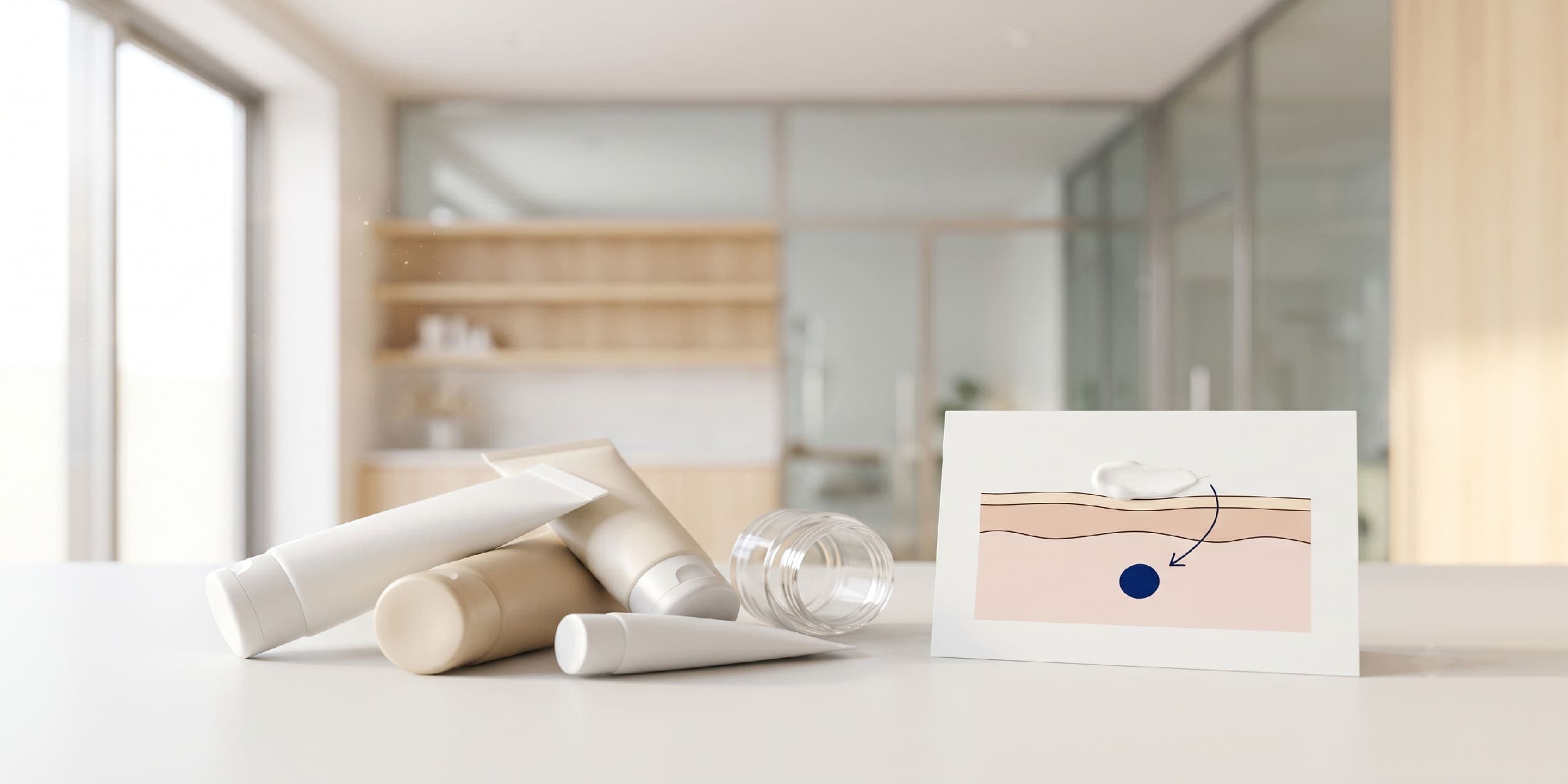
Your tattoo isn't on your skin. It's in it, and specifically in the wrong layer for any cream to touch.
When you were tattooed, needles deposited ink into the dermis — the deeper, living layer of skin beneath the surface. That depth is the whole point of a tattoo: it's why the ink is permanent rather than washing off, because the dermis doesn't shed and renew the way the surface does. Your body sealed the ink in there and largely left it alone.
A cream sits on top of the epidermis, the outer layer. The epidermis exists precisely to be a barrier — to keep things out. For a cream to reach your ink, it would have to penetrate the full thickness of that barrier and deliver something into the living dermis capable of breaking down pigment, without destroying everything else on the way. No over-the-counter cream does this, because a substance that could would be far too dangerous to sell in a tube.
This is the same reason laser works and creams don't: laser passes through the epidermis harmlessly as light and delivers its energy to the ink below. A cream has no way through. It's not a matter of a better formula or more time — it's a barrier the product cannot cross.
Creams aren't a weak version of laser that just needs longer to work — they're addressing the wrong layer of skin entirely, and no amount of time or reapplication changes that. This distinction matters because people assume a cream is simply slower and gentler, and keep using it for months expecting cumulative results. There are no cumulative results to reach the ink. Six months of a cream that can't penetrate the dermis is exactly as effective at removing your tattoo as one day of it: not at all.
What They Actually Do When They "Work"
The testimonials and slightly-faded photos aren't always fabricated. Something is happening — it's just not tattoo removal. There are two mechanisms, and both are bad news.
Cosmetic surface fading. Some creams contain skin-lightening agents like hydroquinone that lighten the epidermis sitting over the tattoo. This can make the tattoo look marginally lighter through the slightly paler skin on top — a cosmetic illusion, not removal. The ink is completely untouched. Stop using it and the effect reverses as your skin returns to normal.
Chemical exfoliation and burning. Other creams contain acids — like trichloroacetic acid (TCA) — that chemically burn off the top layers of skin. Aggressive versions strip the epidermis and can reach into the upper dermis, which is why they cause visible damage. If used harshly enough to affect a trace of ink, they're essentially giving you an uncontrolled chemical burn, and that means scarring, not clean removal.
Neither is removal. One is a temporary illusion; the other is skin damage dressed up as a result.
The chemical-burn creams are the genuinely dangerous ones, and their marketing is careful never to call them what they are. Uncontrolled acid on skin causes burns, scarring, infection risk, hyperpigmentation, and permanent texture change — and it does all of that while the tattoo, which lives deeper than the burn reaches, largely survives. The worst realistic outcome isn't "it didn't work." It's a scarred, discoloured patch of damaged skin with the tattoo still faintly visible underneath it, which is harder and more expensive to address than the original tattoo ever was.
The Real Risks You're Taking
This isn't a harmless waste of money. The downside is real.
- Scarring. Acid-based creams can cause permanent raised or textured scars, especially with repeated or aggressive use.
- Chemical burns. First- to second-degree burns from stronger formulas, sometimes severe.
- Infection. Any product that breaks the skin barrier opens a route for infection, particularly when self-applied without sterile conditions.
- Hyperpigmentation and hypopigmentation. Permanent dark or pale patches, more common and more visible on deeper skin tones.
- Allergic reactions. Contact dermatitis and worse from unregulated ingredients.
- Making later laser harder. Scar tissue from cream damage blocks laser penetration and traps ink, so a botched cream attempt can complicate the professional removal you'll end up needing anyway.
That last point matters most. People often try creams first as the cheap option, damage the skin, and then arrive at a laser clinic with a harder job than they'd have had if they'd done nothing.
There's no regulatory safety net here to protect you, and that's easy to forget when a product is sold on a mainstream shopping site with slick photos. Tattoo removal creams are largely unregulated, ingredient lists are often vague or incomplete, and "natural" or "organic" labelling means nothing about safety — plenty of skin-damaging acids are technically natural. A product looking legitimate and having good reviews tells you it sells well, not that it's safe or effective. The absence of a proven, safe, working topical product isn't a gap in the market waiting to be filled. It's a consequence of the physics.
What About "Natural" Fading Methods?
The same logic dismantles the DIY versions — salt scrubs, lemon juice, sand paste, and the rest.
These work on the identical false premise: abrade or bleach the surface hard enough and the tattoo will lift. All they actually do is damage the epidermis, sometimes badly enough to scar, while the ink sits safely below in the dermis. Salabrasion — scrubbing with salt until the skin breaks down — is an old technique that predates lasers, and it "works" only by essentially wounding the skin down to where the ink is, which is precisely how you get a scar where the tattoo used to be. It's not a gentler alternative. It's a cruder, more damaging one.
Natural-method testimonials tend to come with genuine before-and-after photos, which is what makes them persuasive, and it's worth understanding what those photos actually show. The "after" is usually inflamed, scabbed, or freshly damaged skin where the redness and swelling obscure the tattoo temporarily — or skin that has healed with a scar the photo is angled to flatter. Give it six months and the tattoo is still there under whatever damage was done. A convincing photo of temporarily wrecked skin is not evidence of removal.
Where Your Money Should Actually Go
If you want the tattoo gone, the honest options are few and none of them are in a tube.
- Laser removal — the proven standard, reaching the ink where it lives. Our cost guide breaks down what it really runs, and how many sessions it takes.
- Surgical excision — cutting out small tattoos, appropriate in specific cases.
- A cover-up — if you want different rather than gone, a skilled artist solves it in one sitting, often for less than a removal course.
- Doing nothing — a legitimate choice, and infinitely better than scarring yourself with acid.
The money you'd spend on creams over several months is better saved toward a single proper consultation. A clinic can look at your tattoo and give you real options, none of which involve burning your own skin at the bathroom sink.
Think of it like trying to remove a stain that soaked all the way through into the padding under a carpet. Scrubbing the surface fibres as hard as you like — that's the cream — does nothing to the padding underneath where the stain actually lives, and scrub hard enough and you just wreck the carpet. The stain needs something that reaches the layer it's in. For your tattoo, that something is a laser, and there's no bottle on any shelf that changes where your ink is sitting.
WHY THE DERMIS DEFEATS EVERY TOPICAL CREAM
Your skin has two main layers, and a tattoo exploits the difference between them to be permanent. The epidermis is the outer layer, and it's built to renew constantly — its cells are produced at the bottom, migrate upward, die, and shed, replacing themselves entirely every few weeks. Anything deposited only in the epidermis would slough away with that turnover, which is why a tattoo can't live there. Tattoo needles drive ink through the epidermis into the dermis beneath, the deeper layer of connective tissue that does not shed and renew the same way. Once the ink is there, your immune system encapsulates the larger particles and the pigment simply stays, held in living tissue below the self-renewing barrier. That permanence is the entire design of a tattoo, and it's precisely what makes topical removal impossible: the ink is deliberately located in the one layer a surface product can't reach. For a cream to remove a tattoo, it would need to cross the full thickness of the epidermal barrier — which exists specifically to keep foreign substances out — and then deliver, into the living dermis, a chemical capable of breaking down pigment that the immune system has walled off, all without destroying the surrounding dermal tissue. No topical formulation achieves this, and the reason is a genuine dilemma rather than a missing invention: any substance potent enough to penetrate that deep and dismantle sealed pigment would also be potent enough to cause serious dermal damage, burns, and scarring. This is exactly why the creams that produce any visible effect do so by burning through the epidermis with acids — they're not reaching the ink, they're destroying the barrier, and the visible "result" is wound damage, not removal. Laser works precisely because it sidesteps this whole problem: light passes through the transparent epidermis without harming it and deposits energy only where pigment absorbs it in the dermis. A cream has no equivalent way through, because it interacts with the barrier chemically rather than passing through it as energy.
"Six months of a cream that can't reach the dermis is exactly as effective at removing your tattoo as one day of it — which is to say, not at all."
Exactly What To Do, Day by Day
STOP USING THE CREAM IMMEDIATELY
Tattoo removal creams cannot reach the dermis where ink is trapped. They rely on dangerous chemicals like TCA or hydroquinone to burn away the top layers of your skin.
TREAT ANY CHEMICAL BURNS
If you are experiencing severe redness, blistering, or open wounds from a removal cream, wash the area gently with mild soap and water and consult a doctor immediately.
PROTECT THE DAMAGED SKIN FROM UV RAYS
Skin damaged by chemical creams is highly susceptible to severe, permanent hyperpigmentation. Keep the area completely covered and out of the sun.
SWITCH TO A PROVEN REMOVAL METHOD
Laser tattoo removal (using Q-switched or Pico technology) is the only scientifically proven, FDA-cleared method to safely shatter ink particles without destroying the surrounding tissue.
WAIT BEFORE STARTING LASER
If you have used a cream, you must wait until the skin is 100% healed and normal before beginning laser treatments to avoid severe complications.
What To Never Use
Acid-based removal creams containing TCA or similar
they chemically burn the skin rather than reaching the ink, causing scarring, infection risk, and permanent discolouration while the tattoo survives underneath.
Skin-lightening creams marketed for tattoos
hydroquinone and similar agents only pale the surface skin over the ink for a cosmetic illusion that reverses when you stop, leaving the tattoo completely untouched.
DIY methods like salt scrubs, lemon juice, or sand abrasion
they damage the epidermis without reaching the dermal ink, and abrading down to the ink is just a controlled way of scarring yourself where the tattoo was.
Trying any cream before laser to save money
scar tissue from cream damage blocks laser penetration and traps ink, so a botched attempt makes the professional removal you'll still need harder and more expensive.