DISCLOSURE: This post contains affiliate links. If you purchase through our links we may earn a small commission at no extra cost to you.
The Short Answer
Match the device to your ink first: 1064nm for black, 755nm for green and teal, saline for white or flesh-tone pigment. Then vet the operator — ask what wavelengths their machine fires, demand healed photos at six months rather than fresh ones, and require a patch test before you commit. If they hand you a confident session count at consultation without asking about your smoking, skin type, or who did the tattoo, walk.
Most people pick a removal clinic the way they pick a barber — whichever one is close and doesn't look terrible. That's how you end up eighteen sessions deep on a machine that physically cannot clear the green in your tattoo. Start With Your Ink, Not With Clinics Every other decision follows from this one. Before you look at a single clinic, work out what your tattoo actually needs. Walk outside and look at it in daylight. Clinic lighting hides colours. Name every pigment you can see, including the ones sitting underneath the black. Then match:
- All black or black-and-grey — 1064nm handles it. Nearly every clinic has this. You have the widest choice and the lowest prices available to you.
- Green, teal, or light blue anywhere — you need 755nm. This narrows your options hard, and it's non-negotiable. No number of 1064nm sessions clears green.
- Red or orange — 532nm, widely available, usually keeps pace with black.
- Yellow — difficult for everything. Set expectations low and be suspicious of anyone promising full clearance.
- White or flesh-tone — laser oxidises titanium dioxide to grey-black on the first pulse, permanently. You need saline removal, not laser.
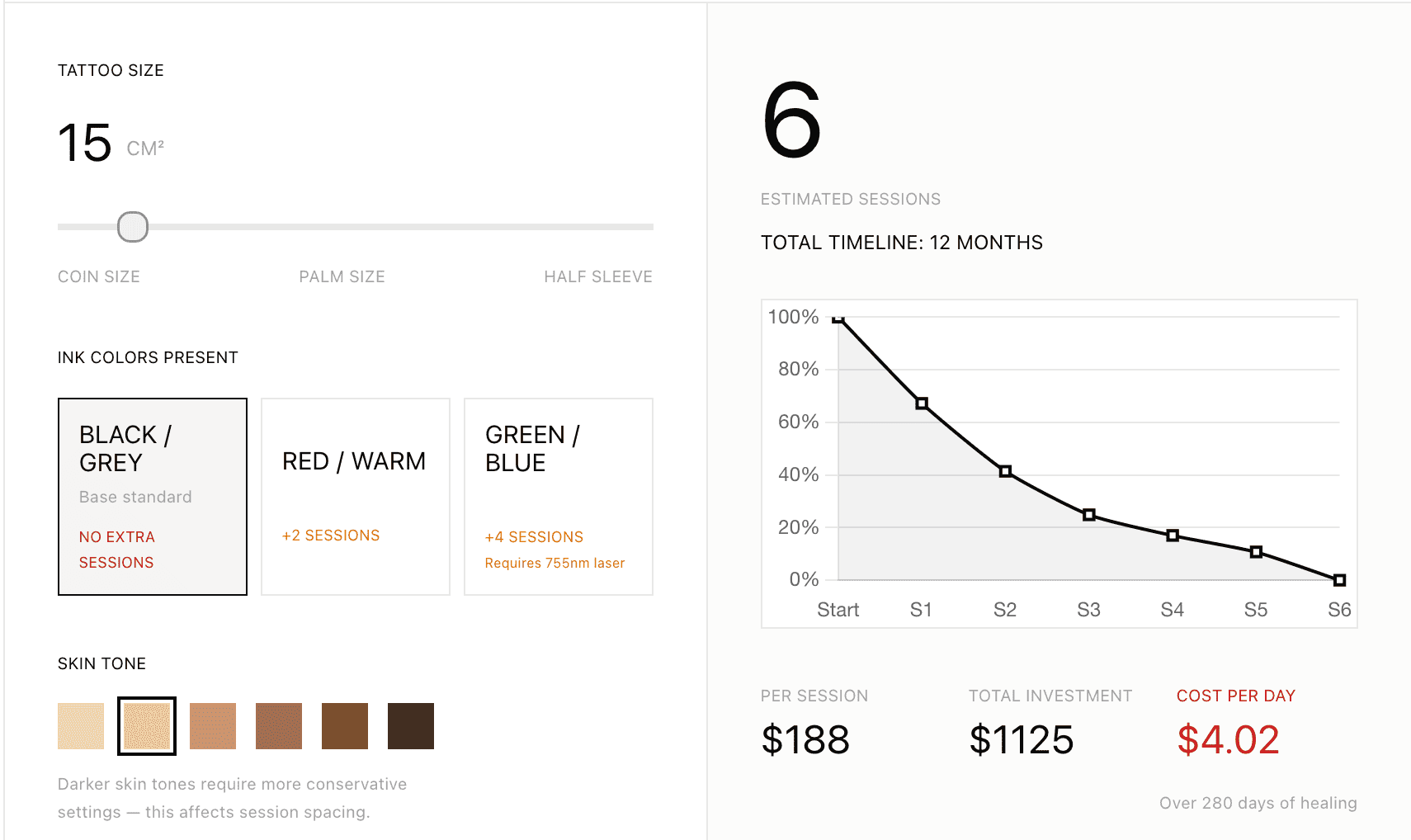
- Full multicolour — you need a clinic with multiple devices, because no single machine wins at everything. Your Fitzpatrick type is the second filter and it's a safety line, not a preference. If you're Fitzpatrick IV–VI, 755nm is off the table — melanin absorbs that wavelength almost as hard as the ink does, and the result is hypopigmentation and burns rather than clearance. You want 1064nm, on either a picosecond device or a Q-Switch. HONEST LIMITATION: This creates a genuine bind for people with darker skin and green ink, and no clinic will tell you it exists. The wavelength that clears your green is the one that damages your skin. The honest answer is slower clearance at 1064nm or 785nm, more sessions, and possibly incomplete green removal — and any clinic promising you fast full clearance on that combination is either untrained or lying. Ask them directly how they handle it. A good tech will name the trade-off unprompted. Vet the Device Before the Clinic The machine sets your ceiling. Here's what to know without becoming an expert. Picosecond versus Q-switched is the main division. Picosecond devices fire pulses roughly a thousand times shorter, which shatters ink mechanically rather than thermally — finer fragments, fewer sessions, less heat damage. Q-switched is the older nanosecond standard, still effective, considerably cheaper, and harder on your skin.
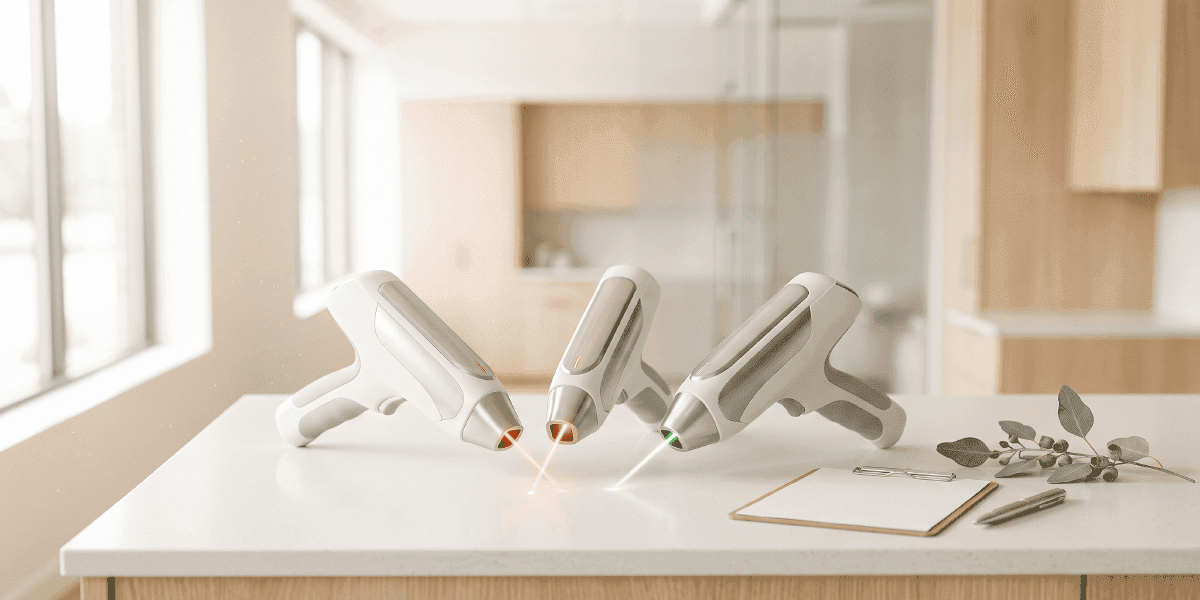
- PicoWay — three wavelengths including 1064nm, safest picosecond option for darker skin, best generalist
- PicoSure — primarily 755nm, the machine to find when green won't leave, unsafe to run aggressively on Fitzpatrick IV–VI
- Q-switched Nd:YAG — 1064nm and 532nm, cheap, widely available, cannot meaningfully clear green or teal Run the total, not the per-session price. Twelve Q-Switch sessions at $150 is $1,800. Eight PicoWay sessions at $300 is $2,400. The pico costs $600 more and finishes five months sooner with less scarring risk — a reasonable trade for many people and a bad one for others. Our full breakdown of PicoWay vs PicoSure vs Q-Switch covers the comparison in detail. HONEST LIMITATION: A skilled tech on a Q-Switch beats a careless one on a PicoWay every single time. Fluence selection, spot size, pulse overlap, endpoint recognition, and knowing when to stop are all operator judgment, and none of it is printed on the machine. If you're forced to choose between the better device and the better operator, take the operator. The device only sets your ceiling. The Seven Questions Ask these in this order. You'll know within ten minutes.
- "What device do you use, and what wavelengths does it fire?" A brand name with no numbers attached means they don't know their own equipment. You want to hear 532, 694, 755, 785, or 1064 without hesitation.
- "Have you treated my Fitzpatrick type on this specific device?" Not "do you treat dark skin." Have they, on this machine, at what settings. Vagueness here is a hard stop for Fitzpatrick IV–VI.
- "Can I see healed results at six months on work like mine?" Fresh post-session photos are just frosting and swelling — they look impressive and tell you nothing. Healed photos at six months on comparable ink is the only portfolio that counts.
- "What's your plan if the green hasn't moved by session six?" A good answer names a different wavelength or refers you out. A bad answer is "it will."
- "Will you do a patch test first?" Non-negotiable if there's any white or flesh-tone pigment, and a good idea regardless. Oxidation is instant and permanent.
- "When will you give me a real session estimate?" The right answer is after session two, once they've seen how your skin clears. A confident single figure at consultation is a booking tool.
- "What are your credentials and who supervises the treatments?" Requirements vary enormously by region — some places require medical supervision, some require nothing at all. Ask what training they have and whether a physician is involved. HONEST LIMITATION: A clinic can answer all seven perfectly and still be wrong for you. These questions filter out incompetence, not mediocrity. The tech who gives textbook answers and then treats you on autopilot at the same settings for twelve sessions is harder to detect at consultation — you'll only spot them by tracking your own photos and noticing that fluence never changed. Ask at session three what they've adjusted since session one. If nothing has, ask why. Red Flags That End the Consultation
- A confident session count without any questions about you. If they didn't ask about your smoking, skin type, or whether the tattoo was professional or amateur, they didn't calculate anything.
- Pressure to buy a package today. A "10-session package" is a price point dressed as a prognosis, and it locks you to one device before anyone knows if that device suits your ink.
- "Guaranteed complete removal." Nobody can guarantee that. Some inks never fully clear.
- No consent discussion of blistering or hypopigmentation. If they won't mention the downsides, they're selling.
- No photography protocol. A serious clinic photographs every session under consistent lighting and shows you the comparison.
- Refusal to patch test.
- Dismissiveness about your questions. You're about to spend a year and thousands of dollars with this person. HONEST LIMITATION: Some good clinics fail one or two of these for boring reasons — a small operation without a photography setup can still have an excellent tech. Treat red flags as weighted rather than absolute. But the confident-number-without-questions flag and the refuse-to-patch-test flag are genuinely disqualifying every time, because both mean they're prioritising the booking over the outcome. Making the Final Call Consult at two or three clinics before committing. It costs you an afternoon and it's the highest-return hour in this entire process. Compare on:
- Device match to your specific ink — the first filter and the heaviest
- Total projected cost, not per session
- Healed six-month photos on comparable work
- Willingness to say "I don't know yet" — the most underrated signal there is
- Travel distance, because you're doing this 8 to 15 times over more than a year Book one session, not a package. Photograph before and after under identical lighting. Wait the full six to eight weeks. Then judge — because your real session estimate lives in how your own skin responded, and our guide to how many sessions walks through calculating it from that data. Think of it like hiring a contractor for a slow renovation. Anyone can quote you a confident number on the doorstep, and the one who says "I'll know more once I open the wall" is usually the one who actually knows what they're doing. Your skin is the wall. Nobody sees inside it until after the first session.
WHY WAVELENGTH CHOICE IS NOT NEGOTIABLE
Ink only breaks if it absorbs the specific wavelength being fired at it, and that isn't a matter of degree — it's close to binary. Every pigment has an absorption spectrum, a narrow band of light frequencies it takes in while reflecting everything else. Green pigment reflects the wavelengths around 1064nm almost entirely, which is precisely why it looks green to you, and it's why a Q-switched Nd:YAG firing at 1064nm passes through green ink without depositing meaningful energy into it. The particle never receives the shock it needs to fracture. This is the mechanism behind the most common failure in tattoo removal: someone spends eighteen sessions and two thousand dollars watching the black around their green clear beautifully while the green itself sits completely untouched. That isn't slow progress or a resistant immune system. It's a pigment that never absorbed anything. Melanin complicates this because it's a pigment too, and it has its own absorption curve that overlaps heavily with the shorter wavelengths. At 755nm — the alexandrite wavelength that green ink absorbs best — melanin absorbs strongly as well, so on Fitzpatrick IV–VI skin the laser energy is competing between the target ink and the pigment in the surrounding tissue. Energy absorbed by melanin becomes heat in living skin rather than a shockwave in an ink particle, and that produces hypopigmentation, burns, and textural scarring. Longer wavelengths solve this: at 1064nm, melanin absorption drops sharply while the light penetrates deeper, which is why 1064nm is the safe choice on deeper skin tones. The trade is unavoidable — the wavelength that clears green is the wavelength that damages darker skin, and no clinic technique gets around the physics.
"Eighteen sessions of 1064nm will not touch green ink — that isn't slow progress, it's a pigment that never absorbed anything."
Already have your design? Each design in our library includes the recommended aftercare protocol for its specific style and placement. Browse verified designs →
Exactly What To Do, Day by Day
IDENTIFY EVERY PIGMENT IN DAYLIGHT BEFORE CONTACTING ANYONE
Take the tattoo outside and name every colour, including anything sitting under the black. Green, teal, light blue, yellow, or white each change which clinic you can use.
FILTER CLINICS BY WAVELENGTH MATCH AND YOUR FITZPATRICK TYPE
Green or teal means you need 755nm. Fitzpatrick IV–VI means 755nm is unsafe and you need 1064nm. Rule out clinics that fail this before comparing anything else.
BOOK CONSULTATIONS AT TWO OR THREE SURVIVORS AND ASK THE SEVEN QUESTIONS
Run the full list in order at each one. The device and credentials answers should come instantly and specifically.
DEMAND HEALED SIX-MONTH PHOTOS AND A PATCH TEST
resh post-session images show frosting, not results. A patch test is mandatory with any white or flesh-tone pigment and worth requesting regardless.
BOOK ONE SESSION AND NEVER A PACKAGE
Photograph before treatment under fixed lighting, wait the full six to eight weeks, then get your real session estimate from how your own skin actually cleared.
What To Never Use
Choosing a clinic on per-session price alone
session count varies far more than price does, so the cheapest chair frequently produces the highest total when the device doesn't match your ink.
Buying a package at consultation
it locks you to one device before anyone knows your real session count or whether that machine can clear your specific pigments.
Accepting 755nm treatment on Fitzpatrick IV–VI skin
melanin absorbs that wavelength nearly as strongly as the ink does, producing burns and hypopigmentation instead of clearance.
Judging a portfolio on fresh post-session photos
frosting and swelling make any result look dramatic, so only healed images at six months on comparable ink tell you anything.