DISCLOSURE: This post contains affiliate links. If you purchase through our links we may earn a small commission at no extra cost to you.
The photos that made you book — the crisp before, the flawless after — are a clinic's highlight reel, chosen from years of work for exactly how good they look. Measuring your own arm against them is the fastest way to feel like a failure while your treatment does precisely what it's supposed to.
What Real Results Look Like Session by Session
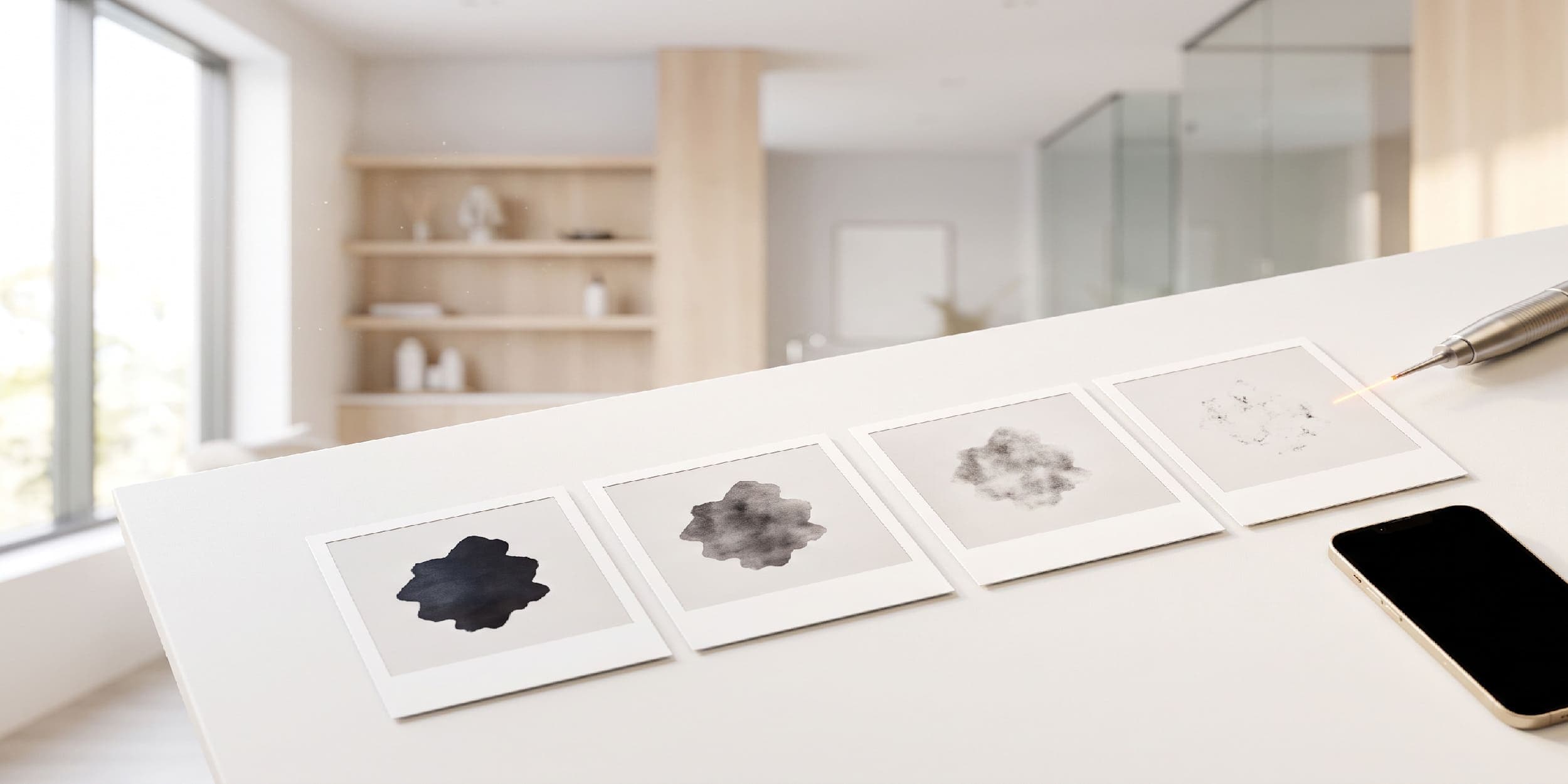
Removal doesn't fade like a photo dissolving evenly. It clears in a specific, uneven pattern that surprises people who expected steady progress.
Sessions 1–2: Often dramatic. The tattoo blurs, softens at the edges, lightens noticeably. This is the most encouraging phase and it sets an expectation the next one won't meet — because what's clearing first is the easy, shallow, low-density ink.
Sessions 3–5: The apparent stall. Little visible change between sessions. The tattoo looks stuck, and this is where most people quit convinced it stopped working. It didn't.
Sessions 6+: Movement resumes, often faster. The tattoo starts breaking apart in patches rather than fading uniformly — bits drop out, gaps appear, the design loses coherence. This looks messier than smooth fading but it's real progress.
Final sessions: Slow and incremental. A faint grey or coloured residue that gives ground reluctantly, session by session.
The uneven breaking-up is normal and it throws people. Ink doesn't sit at uniform depth or density, so it doesn't leave uniformly. Patchy clearing is the tattoo coming apart the way it actually comes apart, not a sign something's wrong. Our full session-by-session guide maps the whole arc.
The advertised before-and-afters skip the ugly middle entirely. No clinic markets the patchy, half-cleared, session-seven look where your tattoo is a broken-up ghost of itself — they show the pristine start and the clean end. So the messy interim, which is the majority of your actual experience, arrives with no reference point and reads as something going wrong. It isn't. You're just seeing the part of the process the marketing carefully omits.
Plateau vs Actual Failure
The stall at sessions three to five looks identical to treatment failure from the outside, which is exactly why people misread it. Here's how to tell them apart.
It's a normal plateau if:
- The black is still fading, however slowly, between sessions
- The tattoo is breaking up unevenly, some areas clearing faster than others
- You still get frosting — the momentary whitening — during treatment
- Overall it's lighter than your session-one photo, even if recent sessions seem flat
It may be actual failure if:
- Zero change across three consecutive sessions with no unevenness at all
- No frosting occurs during treatment
- A specific colour — usually green, teal, or light blue — hasn't moved at all after six sessions
- The tattoo looks identical to where it was four sessions ago in consistent-lighting photos
The colour point is the crucial one. A green section sitting completely untouched while the black around it clears isn't a plateau — it's a wavelength problem, meaning the machine can't clear that ink and never will without the right laser. That's a reason to change clinics, not to wait longer. Our best laser guide explains which wavelengths clear which colours.
Distinguishing plateau from failure genuinely requires good photos, and most people don't take them, which leaves them guessing based on memory — and memory is useless here because the change is slow and your eyes adjust to it daily. Without consistent-lighting before-treatment photos, you can't actually tell whether the tattoo moved, and you'll either quit a working treatment out of false despair or keep paying a clinic whose machine can't clear your ink. The photos aren't optional if you want to judge results honestly.
Why the Last 20% Disappoints Everyone
The endgame is where expectations and reality collide hardest.
The final stretch of ink is the deepest, densest, most stubborn pigment in the tattoo — the particles that survived every previous session precisely because they were hardest to reach. So the last 20% of visible ink takes roughly as long to clear as the first 80% did. If your tattoo is 80% gone at session eight, you are not one or two sessions from finished — you're realistically four to six away, sometimes more.
This produces a specific disappointment. People sail through the encouraging early fading and the satisfying mid-course breaking-up, reach a tattoo that's a faint shadow of itself, and then feel cheated when that last ghost refuses to leave on schedule. Nothing is wrong. That's the shape of the curve, and it's the part the before-and-after photos most obscure, because they jump straight from "tattoo" to "gone."
Some tattoos never reach a completely blank result, and it's dishonest to imply otherwise. A faint grey shadow, a trace of stubborn colour, or slight skin texture change can remain even after a full, successful course — particularly with certain inks, cover-ups, or older tattoos. For most people this residual is faint enough to be a non-issue, invisible unless you know to look. But "removal" doesn't always mean "as if it was never there," and anyone promising you flawless untouched skin as a guaranteed outcome is overselling what the technology reliably delivers.
What Affects Your Final Result
Two people with the same tattoo can end up with different results, and much of the difference is explainable.
- Ink colours. Black and dark blue clear most completely. Green, teal, and yellow are harder, and some traces may persist. White and flesh-tones can oxidise and complicate things.
- The machine used. A device with the right wavelengths for your colours produces a more complete result than one missing them.
- Your skin and health. Circulation, immune function, hydration, and not smoking all affect how completely your body clears fragmented ink.
- Whether you finished. The single biggest factor. A completed course looks entirely different from an abandoned one.
- Original tattoo factors. Depth, density, age, layering, and whether it was amateur or professional all shape the ceiling of what's achievable.
The most common reason people have a poor final result isn't the machine or the ink — it's that they stopped partway. An abandoned removal at the plateau or in the disappointing last stretch leaves a faded, patchy ghost that looks worse than either the original tattoo or a completed removal. The clinics showing flawless afters are showing people who finished. If you're comparing your abandoned or in-progress tattoo to their completed results, you're comparing two different things. Finishing is most of what separates a good result from a bad one.
How to Photograph and Judge Your Own Results
Since you can't trust the clinic's marketing or your own daily eyes, you document it yourself.
- Same everything. Same phone, same spot in the room, same time of day, same lighting, no flash. Consistency is the entire point.
- Include a fixed reference in frame — a mole, a freckle, a ruler — so scale and position stay comparable.
- Photograph before each session, never right after. Post-session skin is inflamed, red, and frosted, which makes the tattoo look darker and misleads you completely.
- Compare across a span, not session to session. Put your session-one photo next to session-five, not four against five. The real progress shows over distance, not between adjacent visits.
- Keep them in one place, in order, so you can see the arc rather than react to the latest frame.
Do this and the plateau stops fooling you, because you'll see in the photos that the tattoo genuinely moved even when your daily eyes swore it hadn't.
Think of it like watching a child grow. Day to day, standing next to them, you'd swear they haven't changed at all — the change is real but too slow to see up close. It's only the pencil marks on the doorframe, months apart, that show how far they've come. Your before-session photos are the pencil marks. Without them you'll insist nothing's happening while the evidence, unmeasured, quietly stacks up.
WHY INK CLEARS UNEVENLY INSTEAD OF FADING SMOOTHLY
A tattoo looks like a single flat image, but under the skin it's anything but uniform, and that's why it doesn't clear evenly. Ink is deposited by hand at varying depths and densities — some particles sit shallow in the upper dermis, others were driven deeper; some areas are lightly shaded, others packed with saturated pigment layered in multiple passes. The laser can only fragment what it reaches at the energy it delivers, so the shallow, sparse, loosely-packed particles shatter and clear first while the deep, dense, heavily-layered ink holds on. This is the physical reason for the pattern people find so unsettling: the tattoo breaks apart in patches rather than fading like a photograph losing brightness, because different regions are literally different removal problems clearing at different rates. What looks like erratic, worrying progress is just the map of how the original ink was laid down, revealed in reverse. The depth gradient also explains why the last portion takes so disproportionately long. The pigment that remains at the end is, by definition, the deepest and densest — the particles that survived every prior session because they were hardest for the laser to reach effectively and hardest for your immune system to clear once fragmented. Each pass shatters a smaller proportion of what's left, and the fragments that are produced sit deeper, with a longer lymphatic journey out of the body. So clearance slows precisely when the tattoo is nearly gone, and the final faint residue can require as many sessions as the dramatic early fading did. None of this is the treatment underperforming — it's the direct, predictable consequence of ink existing in three dimensions rather than as the flat image your eye perceives, and it's why judging progress needs consistent photographs over a span rather than a glance in the mirror between visits.
"The last 20% of ink takes as long to clear as the first 80% — if you're 80% gone at session eight, you're four to six sessions from done, not one."
Exactly What To Do, Day by Day
PHOTOGRAPH BEFORE EVERY SESSION UNDER IDENTICAL CONDITIONS
Same phone, same spot, same time of day, same lighting, no flash, with a fixed reference like a mole or freckle in frame. Never shoot right after a session, when inflamed skin makes the tattoo look darker.
COMPARE ACROSS A SPAN NOT BETWEEN ADJACENT SESSIONS
Put your session-one photo beside session-five rather than four against five. Real progress shows over distance, and adjacent-session comparisons are what make a normal plateau feel like failure.
CHECK WHETHER A STALL IS A PLATEAU OR A WAVELENGTH PROBLEM
A plateau still shows slow fading, uneven breaking-up, and frosting during treatment. A specific colour untouched after six sessions with no frosting is a machine problem, and a reason to change clinics rather than wait.
SET YOUR EXPECTATION FOR THE DISAPPOINTING LAST STRETCH
Understand before you start that the final 20% clears as slowly as the first 80%, so an 80%-gone tattoo is four to six sessions from done. Knowing this prevents the endgame despair that makes people quit near the finish.
JUDGE YOUR RESULTS AGAINST YOUR OWN PHOTOS NOT CLINIC MARKETING
Compare your documented arc to where you started, never to a clinic's advertised best-case afters. The marketing shows people who finished, chosen for how good they look, and it's the wrong yardstick for your in-progress skin.
What To Never Use
Comparing your progress to a clinic's advertised before-and-afters
those are hand-picked best cases showing finished results, and measuring your in-progress or uneven skin against them manufactures false despair about a normally-working treatment.
Judging results from memory instead of photos
the change is too slow for your daily eyes to register, so without consistent before-session photos you can't tell a working plateau from actual failure.
Quitting during the disappointing last 20%
that residual ink is the deepest and densest and clears as slowly as the whole first 80%, so stopping near the end leaves a patchy ghost worse than finishing.
Waiting out a colour that hasn't moved in six sessions
an untouched green or teal is a wavelength problem the machine can't fix, so it's a reason to change clinics, not to keep paying for sessions that can't clear it.