Loading
Tattoo Removal7 MIN READ
Tattoo Removal — What Each Phase Actually Looks Like
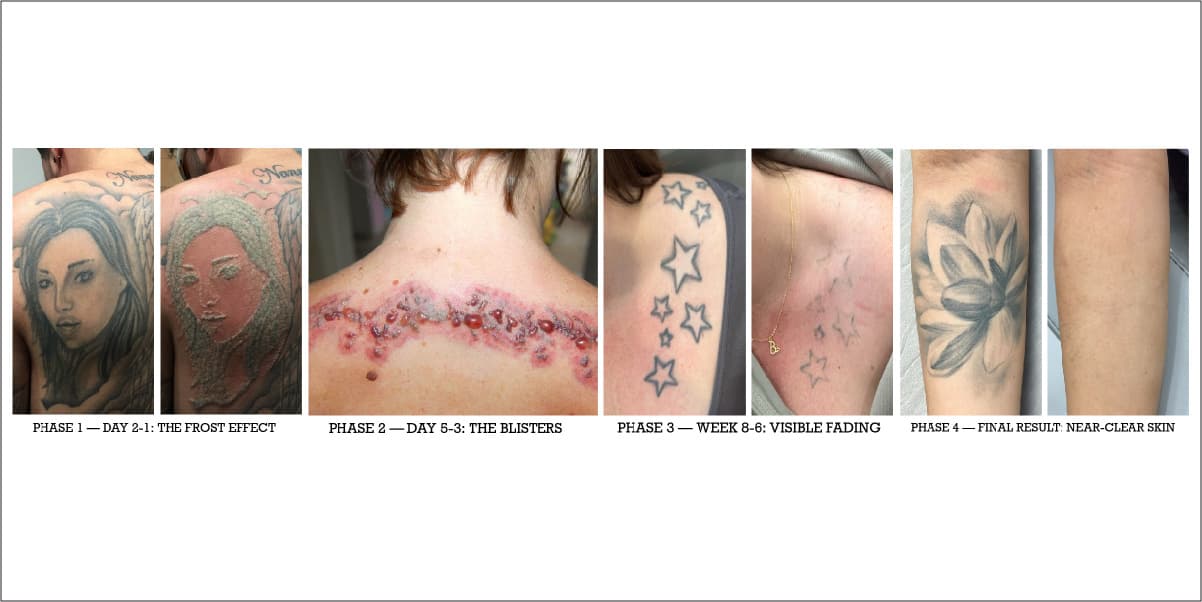
This guide walks you through the four phases of laser tattoo removal in the order you'll actually see them — the frost, the blisters, the fade, and the final result — with a photo of each so you know exactly what you're looking at. The thing most people never learn is that the two scariest-looking phases, the white frost and the blisters, are the most normal parts of the entire process.
By TattoosMap Editorial — Updated May 2026
CONTENTS
The Short Answer
This guide walks you through the four phases of laser tattoo removal in the order you'll actually see them — the frost, the blisters, the fade, and the final result — with a photo of each so you know exactly what you're looking at. The thing most people never learn is that the two scariest-looking phases, the white frost and the blisters, are the most normal parts of the entire process.
Related Removal Guides
- Laser Comparison: Compare pulse mechanisms in our PicoWay vs PicoSure vs Q-Switch Guide.
- Budget & Estimations: Calculate total sessions with our Tattoo Removal Cost Calculator.
- Post-Laser Healing: Read what to expect in our Laser Tattoo Removal Blister Care Guide.
HOW WOUND HEALING AND INK CLEARANCE RUN IN PARALLEL
The laser fires two processes at once. The pulse shatters ink particles through photothermolysis, but it also inflicts a controlled thermal micro-injury on the epidermis and upper dermis — and your skin answers that injury with the standard wound-healing cascade. Neutrophils and macrophages flood in over the first days to clear debris, which is the swelling, heat and frost you feel. Then fibroblasts lay down fresh collagen and keratinocytes migrate across to reseal the surface, and the scab you see is just dried plasma and dead cells protecting that rebuild underneath. This surface repair finishes in four to six weeks. Ink clearance is the slower, invisible half. The same macrophages that cleared wound debris engulf the fragmented ink particles — now small enough to actually transport — and haul them through the lymphatic vessels to the nearest lymph nodes over the following weeks. Your skin resurfaces long before that hauling is done, which is why the tattoo keeps fading after it looks healed. Picture a building site: the scaffolding comes down and the facade looks finished weeks before the trucks have carted away the last of the rubble.
SHARE THIS
"The two phases people panic over most — the white frost and the day-three blisters — are the two most normal things your skin will do in the entire process."
Step-by-Step Sequence
01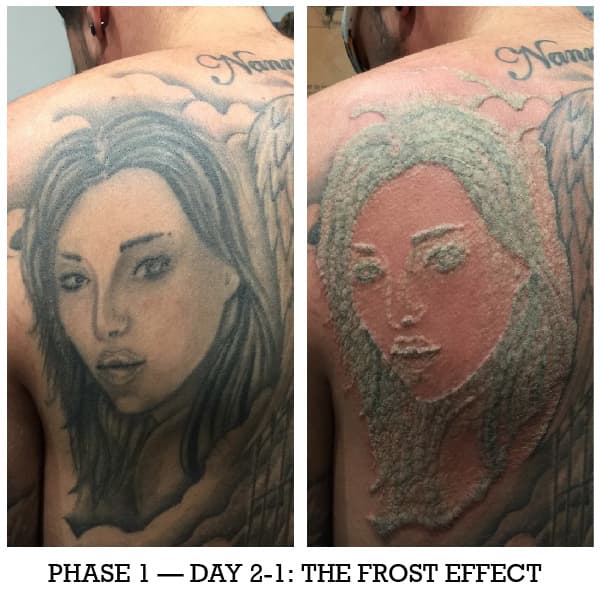
PHASE 1 — DAY 1-2: THE FROST EFFECT
The skin turns chalk-white the second the pulse lands — bright patches sitting right on the ink, red and slightly swollen around them. It stings hot and sharp, like a rubber band snapped on sunburn, and the frost fades to red within 20 to 30 minutes. This is normal and means the laser hit its target.
WARNING
Grey-black discolouration or a deep dull ache under the surface isn't frosting — stop and tell the technician.
02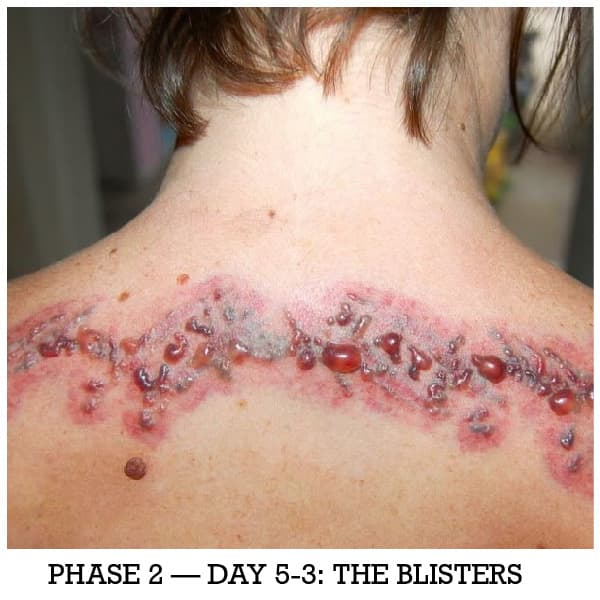
PHASE 2 — DAY 3-5: THE BLISTERS
Clear or blood-tinged bubbles rise directly over the ink, from small and scattered to a single one the size of a grape. They feel tense and tender while the skin around them stays soft. Alarming to look at, completely normal, and the number-one reason people panic-call the clinic.
WARNING
Never pop them — the roof is a sterile barrier over raw dermis, and breaking it roughly triples your scarring risk.
03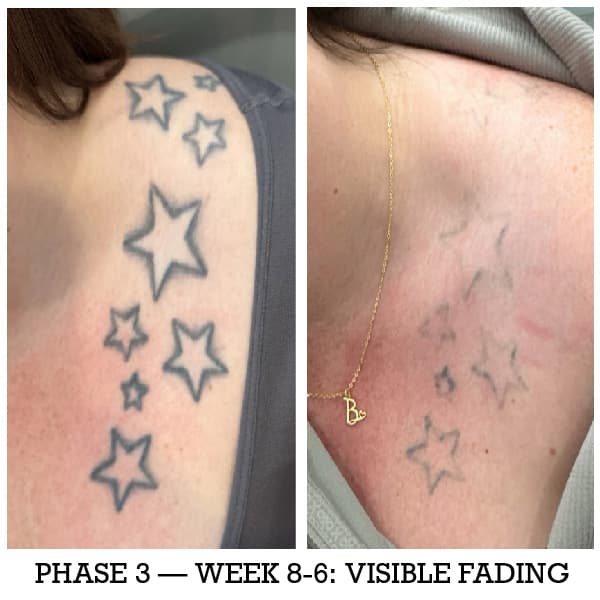
PHASE 3 — WEEK 6-8: VISIBLE FADING
Black ink has gone grey, edges have softened, and fine lines have almost vanished — the tattoo reads as a faded suggestion of itself. The skin feels healed and calm by now. This is the reward phase, and proof the process works.
TIP
Photograph it in the same light and angle as your session-one photo — memory is a terrible measuring tool.
04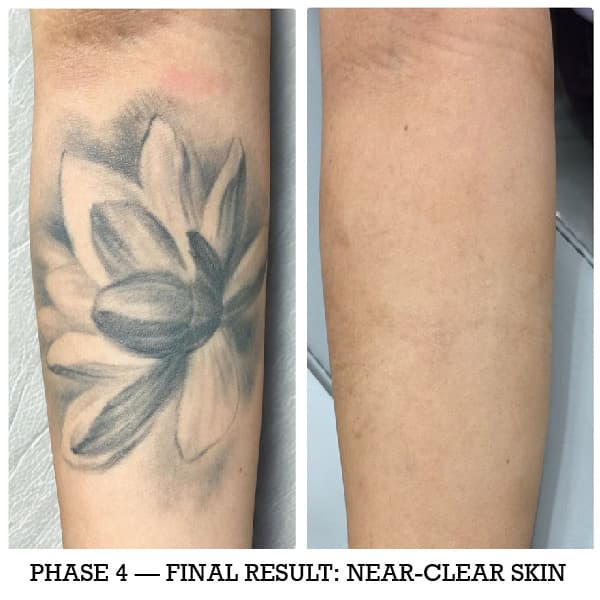
PHASE 4 — FINAL RESULT: NEAR-CLEAR SKIN
What's left is a faint shadow visible mainly in bright or angled light — most people won't see it at conversational distance. There may be a slight tone change or subtle sheen where the ink was. This is the realistic, honest end state, and a genuine result.
WARNING
Judge this at least a year out. Sharp white patches or a firm ridge tracing the old lines aren't normal fading and need a dermatologist.
Frequently Asked Questions
That's frosting, and it's the single best sign the laser worked. The white patches are gas released as the ink particles shatter, sitting directly on the pigment the laser targeted. It fades to red within about half an hour. Uniform white frost on the ink is exactly what should happen — worry only if it goes grey-black or the pain is a deep ache rather than a surface sting.
Yes, and they're one of the most common reasons people panic-call their clinic. Blisters form over the densest ink and a single large one is as normal as several small ones. Frightening to look at, straightforward to heal, as long as you leave them intact. Only worry if they spread well beyond the treated area or fill with thick yellow-green fluid.
Around six to eight weeks after your first session — one full clearance cycle. The skin looks healed by week four, but the pigment keeps clearing underneath for weeks after that. Take comparison photos in identical lighting and angle at the eight-week mark; anything earlier is measuring swelling and scabbing, not results.
Usually not entirely, and any clinic promising blank skin is overselling. The realistic result is a fade to a faint ghost or slight tone change that most people stop noticing. For the majority that's invisible to anyone not looking for it — a genuine win, just not the same as skin that never had a tattoo.
Most tattoos need six to twelve sessions spaced eight to twelve weeks apart, so a full course runs roughly one to two years. The first three sessions do the dramatic fading; the rest chase the stubborn remainder. Colour and ink density drive the count more than size does — green and dense professional work take the longest.
Discussion (0)
Verified Accounts
No public comments yet.
Ready for your next tattoo?
Discover thousands of design subjects and styles on TattoosMap.
NEVER STOP EXPLORING
VIEW ALL GUIDES