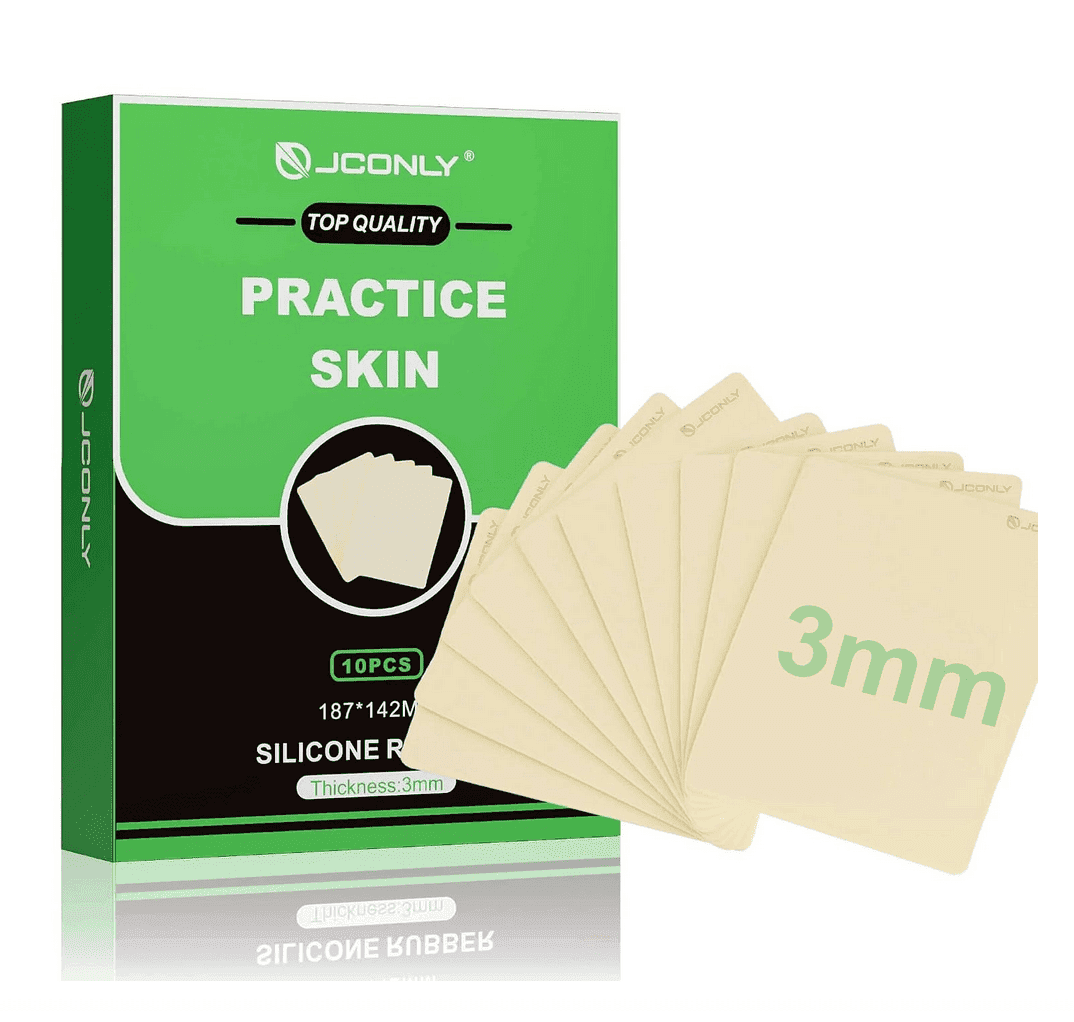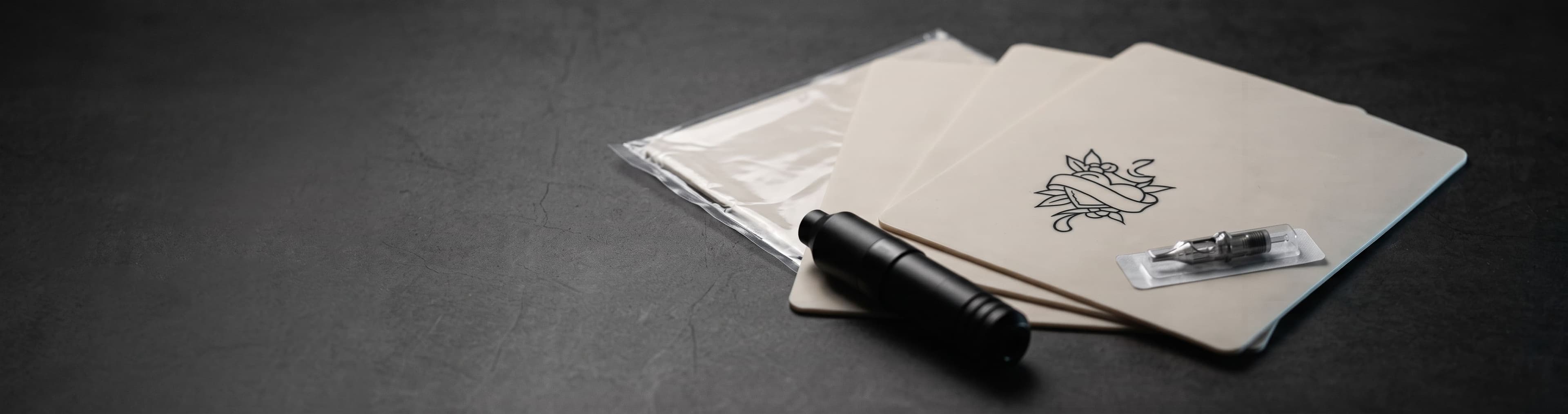
Most people buy the cheapest practice skin they can find, tattoo one line, watch the ink bleed sideways into a grey smudge, and decide practice skin is useless. It's not useless. That sheet was. And the difference between a sheet that teaches you something and a sheet that lies to you is about four dollars.
The Skin Lies To You Or It Doesn't
The whole point of practice skin is building needle control before you touch a person. That only works if the material responds roughly the way human skin does — takes ink on a clean pass, shows a blowout when you go too deep, and lets you feel the difference between the epidermis and the dermis.
Cheap synthetic leather doesn't do any of that. It grabs the needle, accepts ink anywhere regardless of depth, and gives you zero feedback on whether your hand is right. You build habits, but the wrong ones.
Thickness Decides Everything
Thin sheets — anything under 2mm — flex and bounce under the needle. You can't stretch them the way you stretch real skin, and they curl at the edges after a few minutes of work.
Thick sheets stay flat, take a stretch, and give you a surface that resists the needle the way tissue does. The difference between 1mm and 4mm practice skin is the difference between drawing on paper and practising on something that actually pushes back.
"A one-millimetre sheet teaches you to draw. A four-millimetre sheet teaches you to tattoo. Those are not the same skill."
Silicone Versus Synthetic Leather
These are two genuinely different products sold under the same name. Silicone practice skin is moulded to mimic dermis density and it takes ink predictably — what you put in stays roughly where you put it. Synthetic leather is a layered fabric with a coated surface, and it's softer, thinner, and more forgiving than real skin. Both have a use, but you should know which one you're buying.
Silicone is the better training tool. It punishes bad depth and rewards good technique, which is the whole reason you're practising.
What Practice Skin Can't Teach You
It can't stretch. It can't bleed. It can't swell up an hour in and change how the needle sits. And it won't twitch, breathe, or ask you if it's nearly done.
Every artist hits a ceiling on fake skin where the only way forward is a real person, and no amount of premium silicone moves that ceiling higher. Practice skin builds your floor — your baseline hand control and machine comfort. The ceiling is built on people.
Think of it like a batting cage. You can perfect your swing in there, but you won't learn to read a pitcher until someone's actually throwing at you.
The Ranked List
DISCLOSURE: This post contains affiliate links. If you purchase through our links we may earn a small commission at no extra cost to you.
1 — TRUESKIN PLATINUM SILICONE PRACTICE SKIN
BEST OVERALL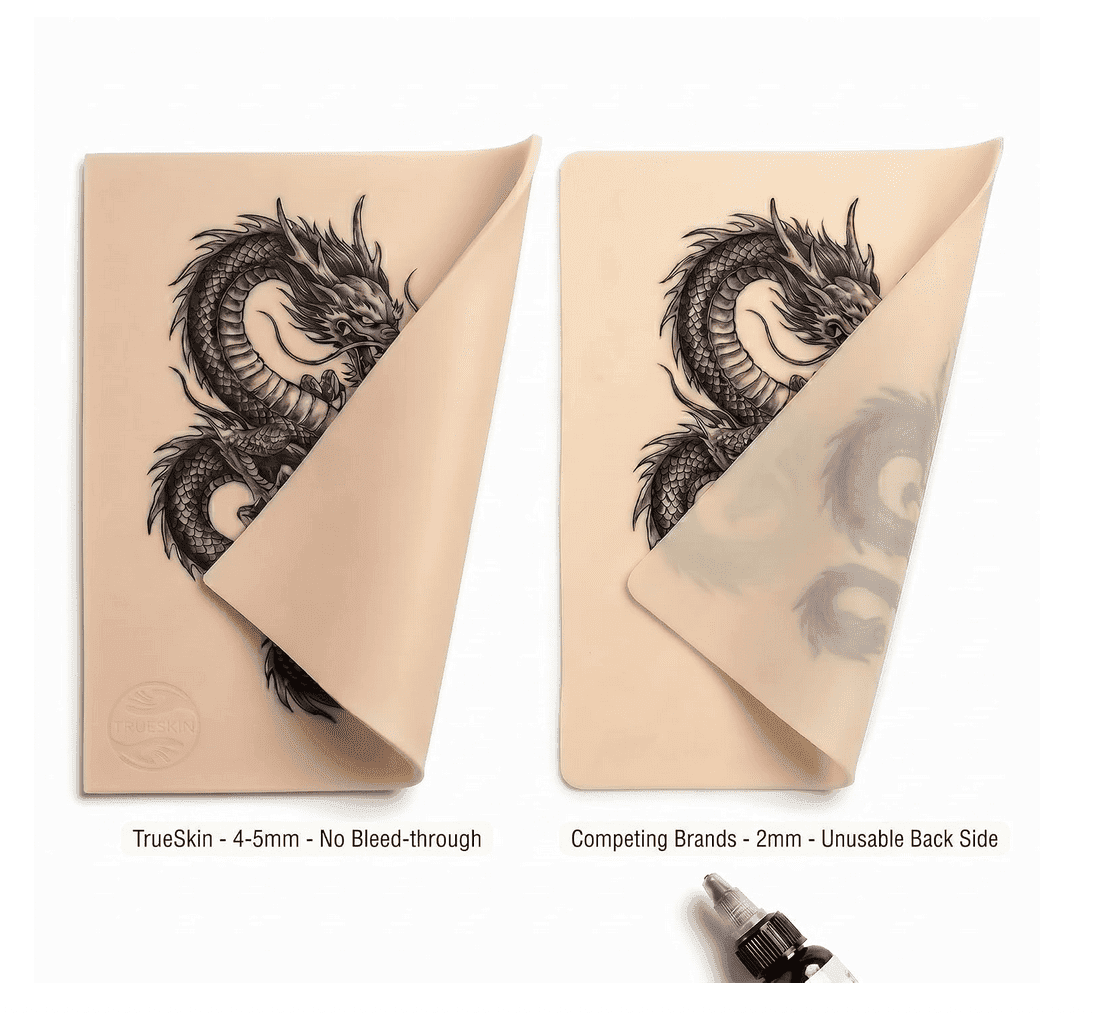
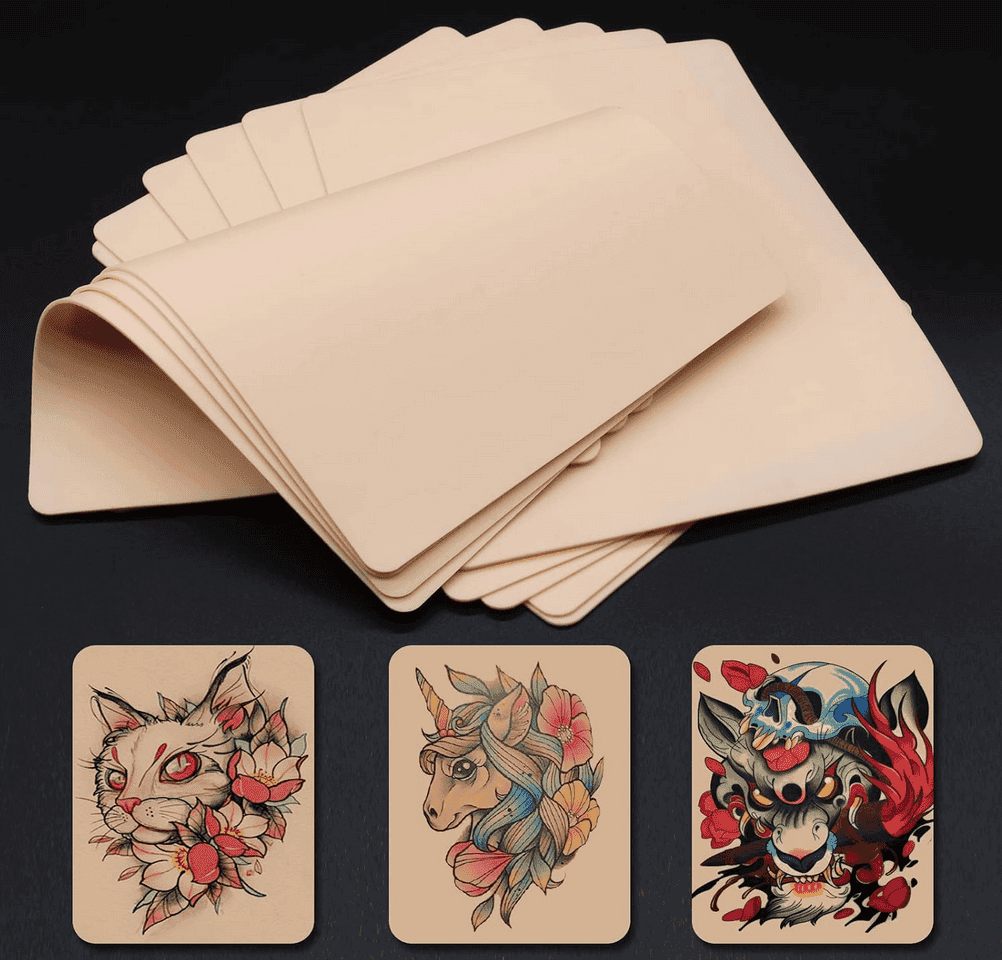
This is the one that changed my opinion on practice skin entirely. At 4-5mm of platinum silicone it actually pushes back against the needle the way tissue does, and the ink sits where you put it instead of bleeding sideways. Both sides are tattooable and thick enough that work on one side doesn't show through to the other. The 8.5 x 11 inch sheet gives you a full drawing-paper canvas to work with, and the material doesn't curl or warp after heavy sessions.
You're paying a premium for a single sheet — most competitors sell ten-packs for similar money, so per-session cost is significantly higher.
WHY MATERIAL DENSITY CHANGES NEEDLE FEEDBACK
When a tattoo needle enters human skin, it passes through the epidermis — roughly 0.1mm of relatively tough barrier tissue — and deposits ink into the upper dermis at a depth of about 1 to 2mm. The dermis is a dense mesh of collagen and elastin that resists the needle and gives the artist tactile feedback through the machine. That resistance is what tells your hand you're at the right depth, and it's the sensation you're trying to replicate on practice material. Platinum silicone at 4-5mm thickness can approximate that density reasonably well. The material has a consistent shore hardness through its cross-section, so the needle meets resistance at a predictable depth rather than punching through to nothing. Thin synthetic leather fails here because the material compresses fully under the needle, bottoming out against whatever surface it's sitting on, and the feedback you get is the table, not the skin. That's why artists who train exclusively on thin sheets over-penetrate on their first real client — they learned to push until they hit bottom, and on a human arm there is no bottom, just deeper tissue and a blowout.
"A one-millimetre sheet teaches you to draw — a four-millimetre sheet teaches you to tattoo, and those are not the same skill."
Already have your design? Each design in our library includes the recommended aftercare protocol for its specific style and placement. Browse verified designs →
Exactly What To Do, Day by Day
SECURE THE SHEET TO A FIRM SURFACE
Tape or clip the practice skin to a flat, hard surface before you start. A sheet that slides under the needle teaches you nothing except bad habits.
STRETCH IT THE WAY YOU'D STRETCH SKIN
Use your off-hand to pull the surface taut. If the material won't take a stretch — thin sheets often won't — you're practising a motion you'll never use on a person.
START WITH LINES BEFORE SHADING
Run straight lines, curves, and circles until your spacing is consistent. Shading is a more advanced skill and it's wasted if your basic line control isn't there yet.
USE THE SAME VOLTAGE AND STROKE YOU'D USE ON SKIN
Don't crank the machine because practice skin feels harder. Match your real settings so the muscle memory transfers. If the ink isn't going in at your normal voltage, the sheet is too thin or the material is wrong.
FLIP AND REUSE BEFORE YOU GRAB A NEW SHEET
Double-sided sheets give you two full sessions per piece. Use side one for lining practice and side two for shading or colour work — it doubles your supply.
What To Never Use
Sheets under 1mm thick
they compress fully under the needle and the feedback you get is the table, not the material, which trains you to push too hard.
Practice skin with a glossy or coated surface
ink sits on top instead of being deposited, and stencils won't transfer cleanly.
Pig skin or animal skin alternatives
inconsistent thickness, ethical issues depending on your market, and they decompose, which isn't a problem silicone has.
Using practice skin as a substitute for an apprenticeship
it builds hand control, not the client management, hygiene protocol, and real-skin judgment that only come from working under someone experienced.