DISCLOSURE: This post contains affiliate links. If you purchase through our links we may earn a small commission at no extra cost to you.
Getting a tattoo on your outer thigh feels like someone drawing on you with a hot ballpoint pen. Getting one on your ribs feels like someone doing the same thing while standing on your chest.
Same needle. Same ink. Completely different experience.
The placement is everything — and the difference between choosing wisely and choosing badly is the difference between a session you forget about by lunchtime and one you are white-knuckling through for four hours.
This chart is based on the consistent reports of people who have been tattooed in every placement on this list. Not marketing copy. Not reassurance. Just honest ratings so you know what you are walking into before you book.
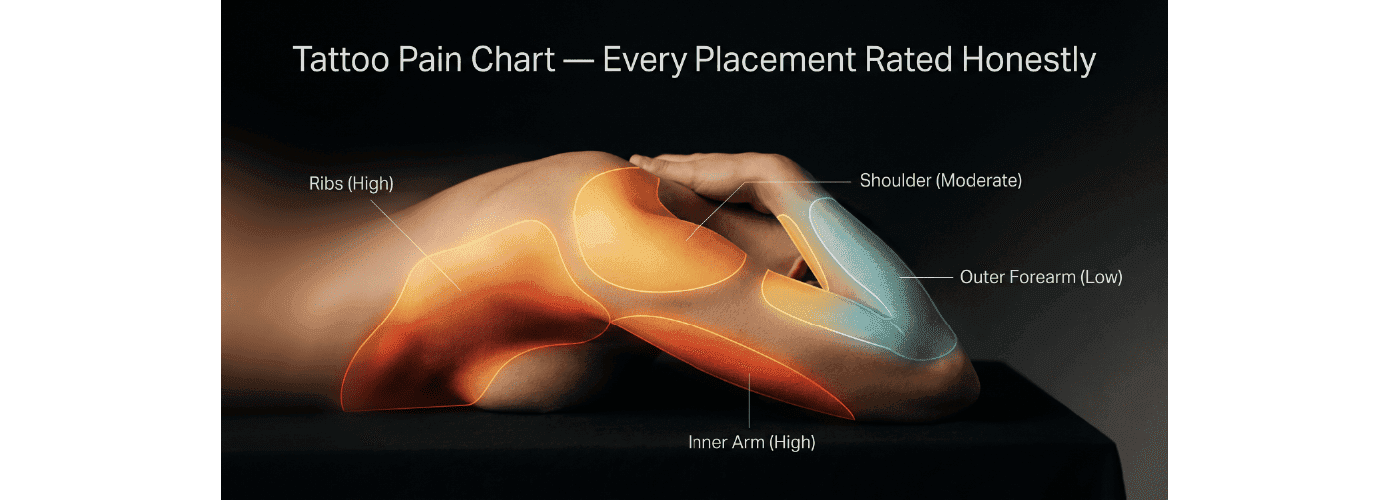
The Complete Tattoo Pain Chart
| Placement | Pain (1–10) | Why |
|---|---|---|
| Outer thigh | 2 | Thick muscle, few nerves, no bone nearby |
| Outer bicep | 2 | Padded muscle, forgiving skin |
| Calf | 2 | Good muscle coverage, tolerant area |
| Outer shoulder | 3 | Fleshy, away from bone |
| Outer forearm | 3 | Manageable — most people's first tattoo |
| Upper back | 3 | Large flat canvas, few nerve clusters |
| Chest (away from sternum) | 4 | Fleshy area, tolerable for most |
| Upper chest | 4 | More tolerable than sternum area |
| Hip |
Why Placement Controls Everything
Pain in tattooing comes from three things working together — and understanding them changes how you read this chart.
Skin Thickness
Your skin is not the same thickness everywhere. Over the outer thigh you have layers of tissue between the needle and anything sensitive. Over the shin you have almost nothing — the needle is essentially working centimetres from bone with a thin layer of skin between them.
Thin skin means the needle hits nerve endings closer to the surface with less to absorb the impact. That is why hands, feet, shins, and the front of the neck register so much higher than the thigh or bicep.
Nerve Density
Some areas of your body are simply wired with more nociceptors — the specialised nerve endings that detect tissue damage and send pain signals to the brain. Your hands and feet have an extremely high concentration of these because evolutionarily they needed the most precise sensory feedback. The result is that tattooing them feels like a completely different category of experience compared to the upper arm.
The armpit, inner thigh, and groin register high on this chart for the same reason. The body dedicates more nerve coverage to areas that need finer sensitivity.
Bone Proximity and Vibration
When a tattoo needle works over bone the vibration travels. This is the thing people do not expect about the spine and the ribcage — it is not just the skin being needled, it is the feeling of reverberation moving through the skeletal structure beneath.
Some people describe spine work as feeling like the vibration is in their teeth. That is not an exaggeration. It is physics.
The Placements That Surprise People
The Outer Thigh Is Gentler Than Almost Anywhere
Most people go in expecting the thigh to be painful because it is a large area. It is consistently one of the easiest placements on the body. The muscle coverage is thick, the nerve density is low, and there is no bone for the needle to reverberate against. If you want a large piece and you are nervous about pain, the outer thigh is genuinely the best place to start.
The Ribs Are Not What People Think
People know ribs hurt. What they do not expect is the specific character of the pain — the fact that every breath moves the skin while the artist is working, and that you spend the session essentially trying not to breathe deeply because each inhale shifts the canvas.
It is not just the pain level. It is the relentlessness of it. You cannot breathe your way through a rib piece the way you can breathe through work on your arm.
Feet Hurt For a Different Reason
Foot tattoos hurt because the skin is exceptionally thin and the bone is immediately beneath it — but they also hurt because the foot is constantly trying to flex and move away from the needle. Your body has a deep instinct to withdraw from pain, and nowhere is that more pronounced than the sole or the top of the foot.
They also heal poorly compared to almost anywhere else, which means the session is only the beginning of the difficulty. Your artist will almost certainly want to touch them up.
How to Manage Pain By Placement
Use Numbing Cream for High-Pain Areas
Topical anaesthetics applied under cling film for 45 to 60 minutes before a session genuinely reduce the sensation on painful placements. They work better on some areas than others — ribs and spine are harder to numb completely because the vibration travels through bone, not just skin. Hands and feet respond well.
Our numbing cream guide covers which products work and the one timing rule most people get wrong.
Keep Sessions Shorter on Painful Placements
A two-hour session on your outer arm is very different from a two-hour session on your ribs. If you are working on a high-pain area, shorter sessions are not weakness — they are strategy. Fatigue amplifies pain significantly. The first hour on your ribs and the third hour on your ribs are not the same experience.
Eat Before You Go
Blood sugar matters more than most people realise. Fasting before a painful session is one of the most reliable ways to make it worse than it needs to be. A proper meal two hours before — not a snack, a meal — gives your body the resources to regulate its pain response more effectively. Do not skip this.
Breathe Deliberately
Box breathing — four counts in, four counts hold, four counts out — genuinely reduces pain perception during difficult passes. It keeps your nervous system from escalating the signal. Most people hold their breath instinctively when the needle hits a painful spot. That makes it worse.
Talk to Your Artist
Every experienced tattoo artist expects clients to need breaks during difficult placements. Asking for thirty seconds is not an inconvenience. Artists who make clients feel like breaks are a problem are not good artists to work with.
"The least painful tattoo is not always the smallest one — it is the one placed where your skin has the most padding between the needle and the bone beneath it."
Does Pain Differ Between Men and Women?
Generally yes — but not in the way most people expect.
Women tend to report more tolerance in fleshy areas like the outer thigh and upper arm, which research links to a higher ratio of subcutaneous fat in those regions acting as natural cushioning. Men tend to struggle more with bony placements — ribs, spine, sternum — where fat coverage is thinner and bone proximity is the dominant factor.
Hormonal fluctuations also play a real role. Many women report that the same placement feels more intense in the days before menstruation. This is not psychological — it reflects genuine changes in pain threshold driven by hormone levels.
The practical advice is the same regardless of gender: placement anatomy matters more than your sex. A man with a naturally lean build will find rib work harder than a woman with more natural padding in that area. The chart above applies to both — with the honest note that individual variation swamps the gender difference in most cases.
HONEST LIMITATION
Pain tolerance is genuinely individual in ways this chart cannot fully capture.
The same rib placement can be a 6 for someone with high natural pain tolerance and a 10 for someone who finds needles difficult under any circumstances. Anxiety amplifies pain significantly — a nervous first-timer often experiences more pain than a relaxed veteran in the same placement.
Chronic pain conditions, certain medications, and hormonal fluctuations across the menstrual cycle all affect how pain registers. The chart is a reliable guide to relative difficulty across placements. It is not a promise about your specific experience.
The most useful thing this chart tells you is not a number — it is the direction. Outer thigh is easier than ribs. Ribs are harder than shoulders. That hierarchy holds even if your personal numbers differ from the ones listed.
FAQ
What is the most painful tattoo placement?
The floating ribs, nipple area, and groin consistently rate as the most painful placements across reported experience. What they share is extremely high nerve density, minimal skin cushioning, and direct proximity to sensitive tissue or bone. The front of the neck and hands follow closely. If you are planning work in any of these areas, go in with realistic expectations and plan for shorter sessions.
What is the least painful place to get a tattoo?
The outer thigh is the most consistently reported low-pain placement for a large piece. The outer bicep and calf follow closely. These areas combine good muscle coverage, lower nerve density, and no significant bone proximity — the three factors that make a placement tolerable.
Does tattoo pain get easier with more tattoos?
Partly. You get better at knowing what to expect and at managing your response to it — which genuinely helps. But the placement determines the pain more than your experience level does. A veteran with twenty tattoos still finds their ribs more painful than their thigh. Experience helps you cope. It does not change the anatomy.
Should I use numbing cream for painful placements?
Yes, if you want to. Numbing cream applied correctly — under cling film, 45 to 60 minutes before — meaningfully reduces sensation in most placements. Check with your artist first as some prefer to work without it because it can slightly change skin texture. Most have no objection. Our numbing cream guide covers the specifics.
How long does tattoo pain last after the session?
The sharp pain stops almost immediately when the needle stops. What follows is more like sunburn — a surface soreness that typically peaks in the first few hours and fades significantly within 24 to 48 hours. High-pain placements like ribs and spine can remain sore for two to three days. The area will be tender to touch during the first week of healing, but the acute pain of the session itself ends when the session ends.
Why This Matters
Pain in tattooing is detected by nociceptors — specialised nerve endings in the dermis that signal tissue damage to the brain. Their density varies significantly across the body, which is why hands and feet register pain far more intensely than the outer thigh. Skin thickness compounds this: thin skin over bone gives the needle less to absorb before it reaches nerve-dense tissue, which is why the shin, spine, and ribcage consistently rate as the most painful placements. The vibration of needle against bone — particularly pronounced on the spine and sternum — adds a second pain mechanism that does not exist in well-padded placements. Blood sugar, anxiety, and fatigue all amplify nociceptor sensitivity, which is why the same placement can feel meaningfully different on different days.
"The least painful tattoo is not always the smallest one — it is the one placed where your skin has the most padding between the needle and the bone beneath it."
Already have your design? Each design in our library includes the recommended aftercare protocol for its specific style and placement. Browse verified designs →