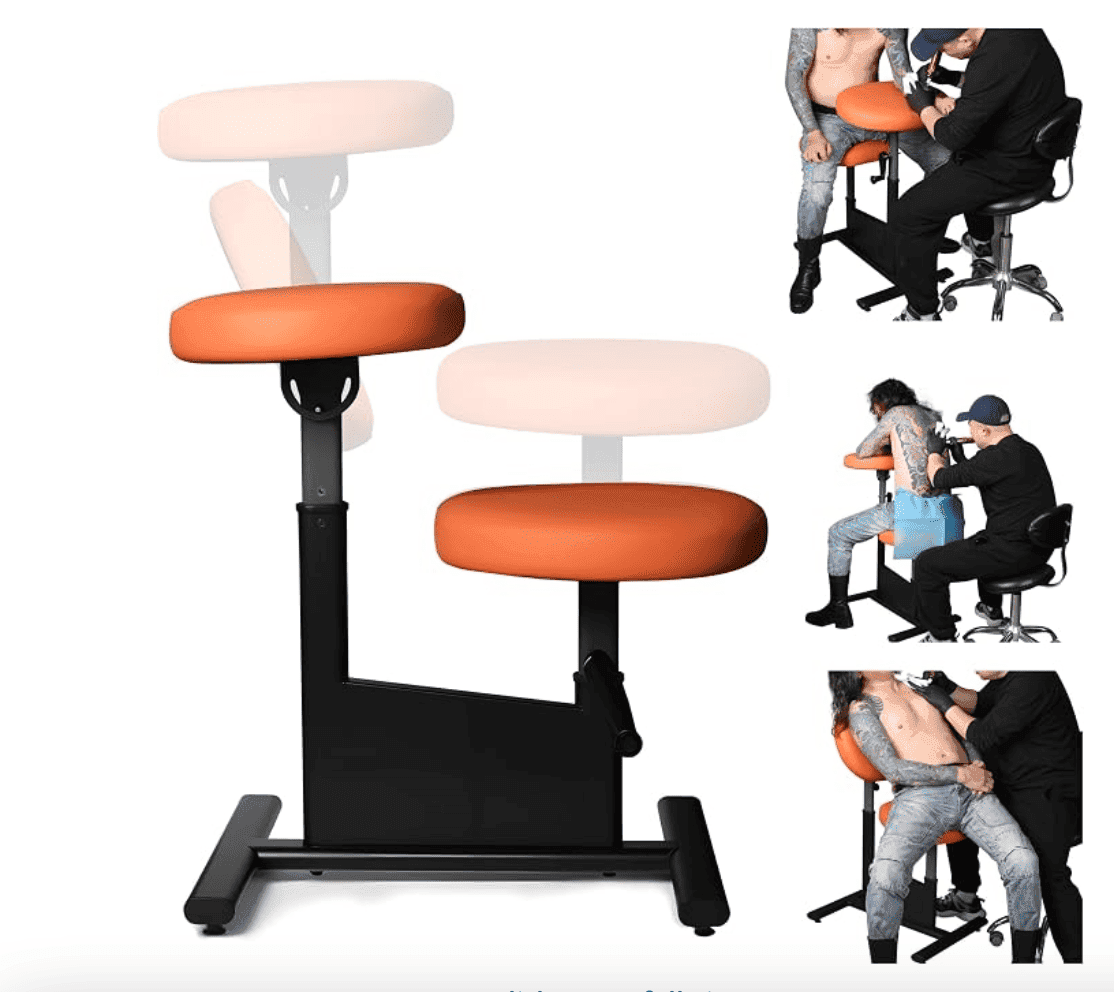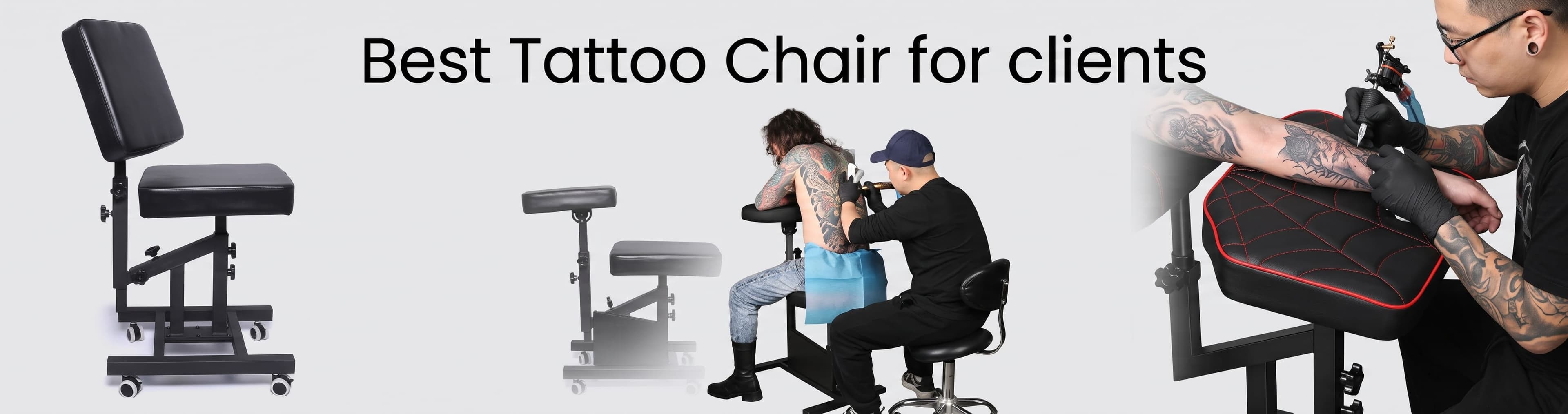
Most artists buy the chair last. Machine, ink, needles, lights, cabinet, and then whatever's cheapest to sit the client on. Six months later they're wondering why their lines get shakier after the two hour mark and why their lower back hurts on Sundays. The chair was never the afterthought — it was the thing holding both bodies in position the whole time.
Clients Move Because They Hurt
A client sitting on a stool holding their arm out is doing isometric work. Their shoulder is loaded, their muscles fatigue, and somewhere around the twenty minute mark they start shifting without even noticing.
You feel it as a client who "can't sit still." They're not being difficult. They're holding a position no one can hold.
Proper armrest support removes that load entirely. The limb rests, the muscle stops working, and the small involuntary movement stops with it.
The Chair Is Also Your Chair
Half the value here is on your side of the session. If the client's arm sits at the wrong height, you compensate by bending forward, and sustained spinal flexion is what ends tattoo careers early.
"Your client's chair height is what decides whether you spend four hours sitting upright or four hours folded over their arm."
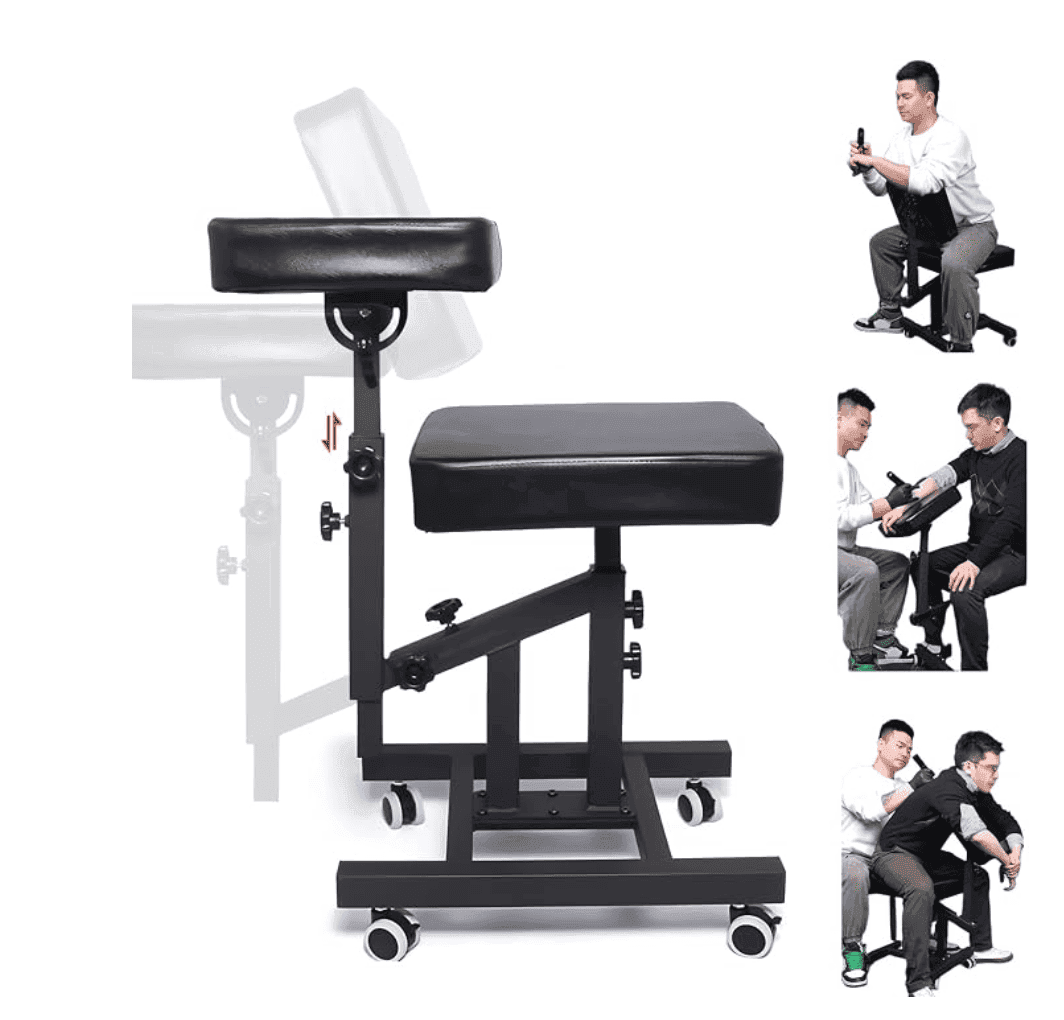
A chair that adjusts on both axes lets you bring the work to your eye line instead of dropping your eye line to the work. That's the whole point of dual height adjustment, and it's the feature people skip to save twenty dollars.
Weight Rating Is Not A Detail
This is the spec worth reading twice. There's a real gap between chairs rated for 220 lbs and chairs rated for 400 lbs, and it isn't marketing padding — it's frame gauge and weld quality.
If you tattoo a normal range of body types, the lower rating will eventually be a problem, and it'll be an uncomfortable conversation when it is. Buy for the clients you'll actually have.
What A Chair Can't Do
It won't fix a client who's anxious, caffeinated, or underfed. Support removes muscle fatigue, not adrenaline, and a nervous first-timer will still twitch in the most supportive chair on the market.
It also won't fix your posture on its own. You still have to actually adjust it every session instead of leaving it where the last person left it, and you still have to get up and move. And if your back already hurts most days, that's a physio conversation, not a furniture purchase.
Think of it like a tripod. It doesn't make the photograph. It just removes the shake you couldn't see yourself adding.
The Ranked List
DISCLOSURE: This post contains affiliate links. If you purchase through our links we may earn a small commission at no extra cost to you.
1 — POARMEEY ADJUSTABLE TATTOO ARMCHAIR
BEST OVERALL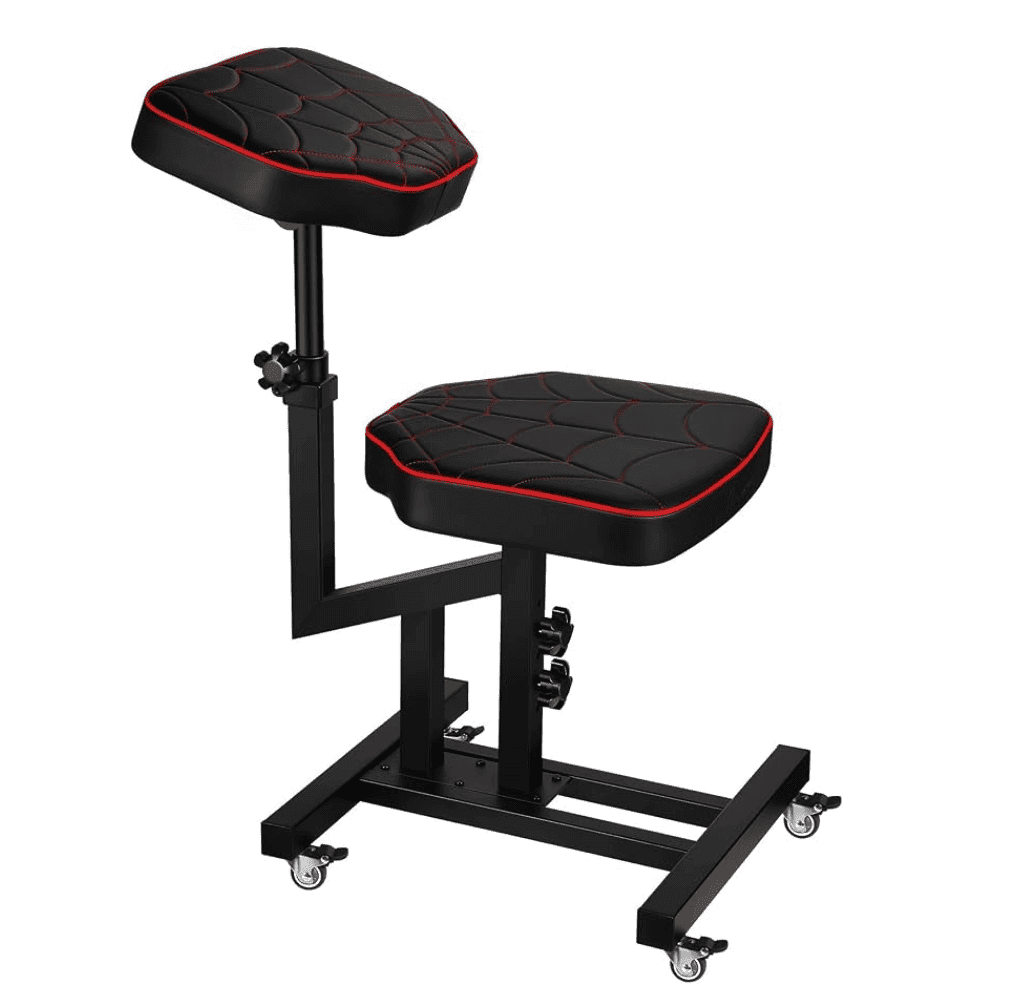
The armrest folds all the way flat to 180°, which is what makes this usable for inner arm, outer arm, and leg work without repositioning the client every twenty minutes. The spider web cushions are firmer than they look — just under two inches of foam under eco-leather that wipes clean without cracking. Four silent castors mean you can nudge the whole thing into position mid-session without lifting anything.
It's rated to 220 lbs, which is genuinely low for a client chair and rules it out for a real share of the people who'll sit in it.
WHY MUSCLE FATIGUE CAUSES INVOLUNTARY TREMOR
When someone holds a limb in a fixed position without support, the muscle contracts isometrically — tension without movement. Sustained isometric contraction compresses the blood vessels running through the muscle, which restricts oxygen delivery to the exact fibres doing the work. Those fibres shift toward anaerobic metabolism, metabolic byproducts accumulate, and motor units start firing asynchronously to share the load. That asynchronous firing is physiological tremor, and it's involuntary. Your client cannot suppress it by concentrating harder, which is why telling someone to hold still stops working after the first hour. Supporting the limb ends the contraction and the tremor disappears with it. The same mechanics apply to you, in slower motion. Leaning forward over a chair that's set too low puts your spine into sustained flexion, and flexion loads the anterior of your intervertebral discs while your erector spinae muscles work continuously to hold you there. Discs don't have a direct blood supply — they get nutrients through fluid exchange driven by movement and pressure change — so hours of static loading in one position is genuinely bad for them. Setting the client's arm at a height that lets you sit upright isn't comfort. It's the difference between a twenty-year career and a ten-year one.
"Your client isn't fidgeting because they're difficult — an unsupported arm starts tremoring involuntarily around the twenty minute mark, and no amount of concentration stops it."
Already have your design? Each design in our library includes the recommended aftercare protocol for its specific style and placement. Browse verified designs →
Exactly What To Do, Day by Day
SET YOUR OWN SEAT HEIGHT FIRST
Sit down, plant both feet, and get your thighs level before you touch anything else. Every other adjustment references this one.
BRING THE WORK TO YOUR EYE LINE
Raise the armrest until the tattoo area sits at your natural sightline without you leaning in. If you're bending forward to see, it's still too low.
SUPPORT THE WHOLE LIMB, NOT THE ELBOW
Position the pad so the forearm rests along its length rather than balancing on a single point. Point support just moves the fatigue somewhere else.
LOCK THE WHEELS BEFORE THE FIRST LINE
Toggle the castors off or wedge the base once the client is settled. A chair that rolls two centimetres mid-line is a touch-up.
RESET AND WIPE BETWEEN EVERY CLIENT
Wipe the vinyl with a surface disinfectant and return the chair to neutral height. Starting from the last client's settings is how you end up hunched all day.
What To Never Use
Fabric or cloth upholstery
it absorbs plasma and ink, can't be disinfected properly, and has no place in a studio.
Chairs with a single fixed height
you'll spend the session compensating with your spine because the chair won't compensate for you.
Cracked or split vinyl
once the surface breaks, disinfectant can't reach what's underneath and the seam becomes a reservoir.
Hard plastic castors
they scrape floors, snag on cable, and make noise every time you shift a client's position.