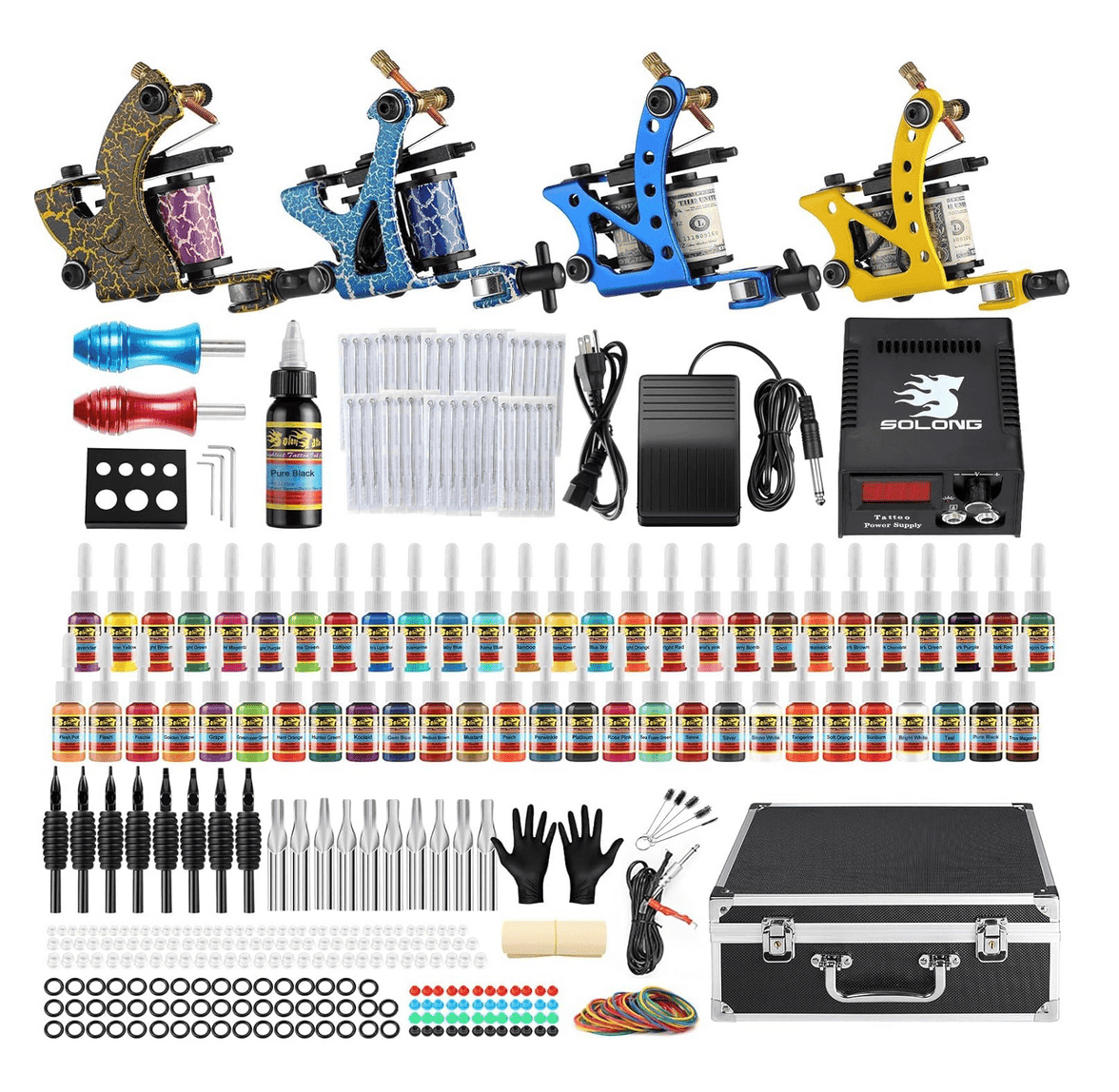
Every beginner googles "best tattoo machine kit," buys the one with the most pieces in the photo, and assumes more stuff means more value. It doesn't. Half the items in a 200-piece kit are ink caps, rubber bands, and disposable grips you'd buy for pennies anyway. The machine and the power supply are the only two things that matter, and the rest is packaging.
Coil Machines Teach You More And Punish You Harder
A coil machine uses electromagnetic coils to drive the needle bar, and the contact screw, spring tension, and armature bar all need to be tuned to each other before the machine runs right. That's not a flaw — that's a mechanical education.
But it also means your first session involves troubleshooting a machine instead of practising lines. The buzzing is loud, the setup is fiddly, and if the contact screw is wrong by half a turn the needle either barely moves or hammers like a sewing machine.
"A coil kit doesn't just teach you to tattoo — it teaches you to be a mechanic first and an artist second, and most beginners don't know that's what they signed up for."
Rotary Machines Let You Skip To The Work
A rotary pen has one moving part, no tuning, and runs the moment you press the pedal. You plug it in, seat a cartridge, and you're lining.
That simplicity is the whole argument. Every hour you spend tuning coils is an hour you're not building hand control, and hand control is what decides whether your lines are straight. For a raw beginner, removing the machine variable and just practising on practice skin is worth more than understanding spring tension.
What The Kit Pieces Are Actually Worth
Three things in any kit matter: the machine, the power supply, and — if it's a coil setup — the foot pedal. Everything else is consumable.
The ink in budget kits is practice-grade at best. The needles are fine for fake skin and questionable for anything else. The power supply is the silent risk, because an unstable voltage output causes inconsistent needle depth that shows up as patchy healing, and the cheap digital units in these kits are where manufacturers cut corners first.
What No Kit Can Replace
A kit puts tools in your hands. It doesn't teach you depth, stretch, sanitation, or how to talk to a nervous client sitting in your chair for the first time.
Every working artist learned under someone else, and the kit is a starting point for that process, not a shortcut around it. The best thing a first kit can do is be reliable enough that when something goes wrong, you know it was your hand and not the machine.
Think of it like a learner car. Nobody expects the first one to be good — they expect it to run consistently enough that the driver can actually learn to drive.
The Ranked List
DISCLOSURE: This post contains affiliate links. If you purchase through our links we may earn a small commission at no extra cost to you.
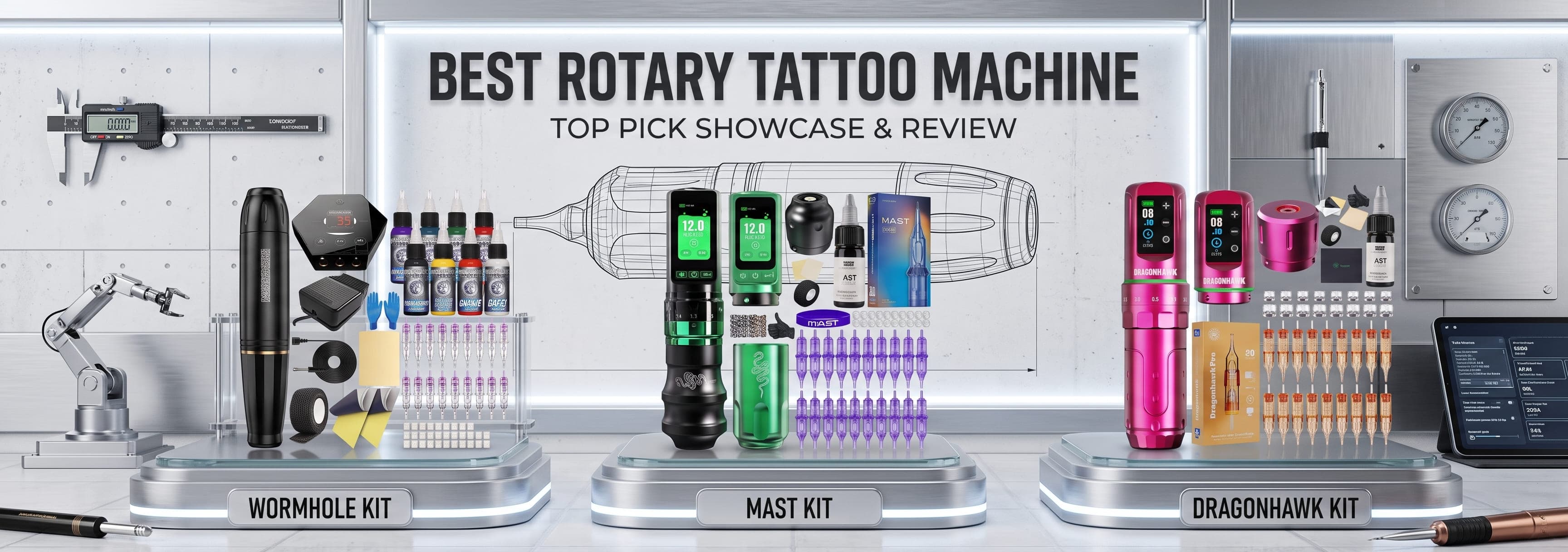
1 — MAST FLASH ROTARY TATTOO MACHINE KIT
BEST OVERALL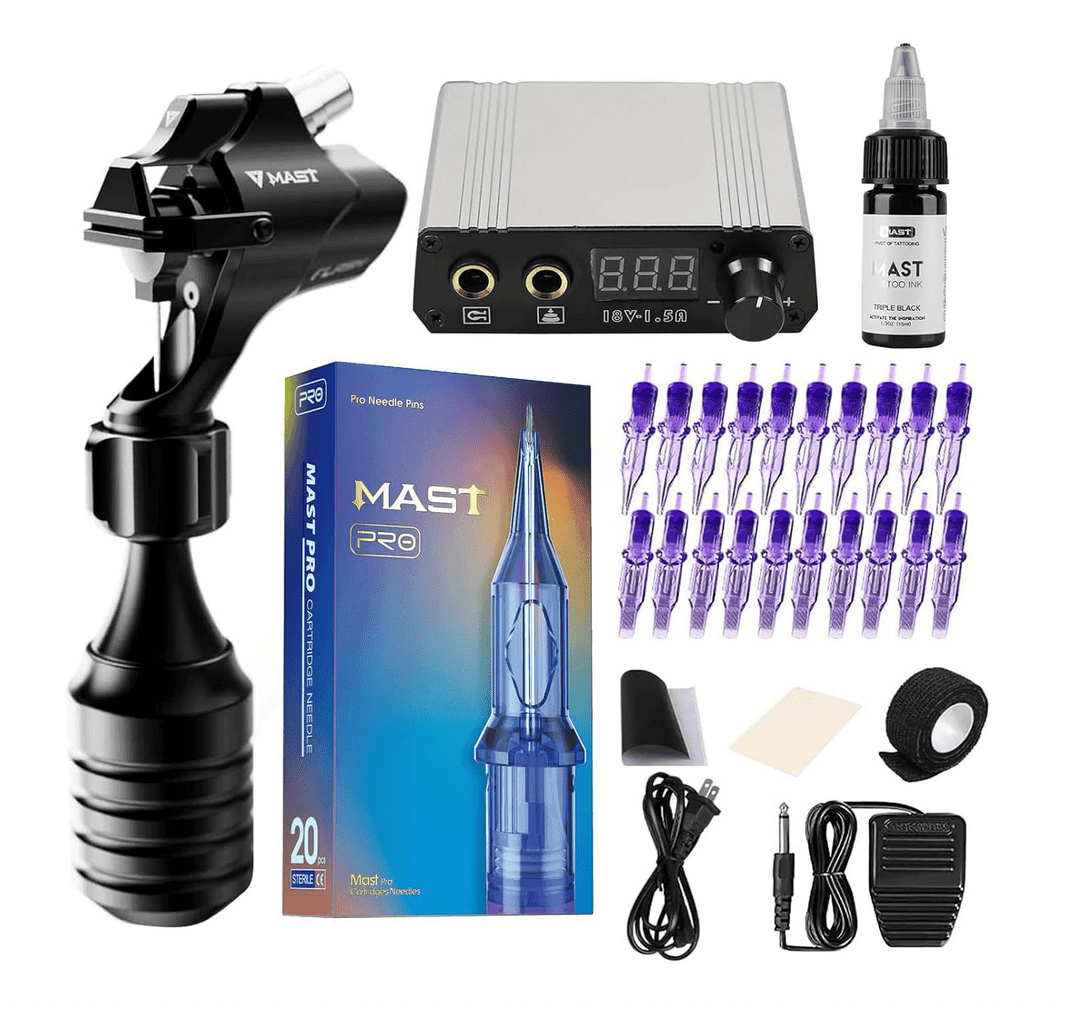
The Flash pen is lighter than it looks in photos, and the 3.5mm fixed stroke is the right middle ground for a beginner — short enough for clean lining, long enough that basic shading doesn't require a second machine. The cartridge grip adjusts needle protrusion from 0 to 4.5mm with a click system you can feel through gloves, and the grip itself is autoclave-safe. The included power supply is stable and the 20 cartridge needles are split between liners and magnums, which is the right starter mix.
Fixed 3.5mm stroke means you can't dial shorter for fine line or longer for heavy colour packing — you'll outgrow this machine the moment you want to specialise.
HOW COIL DUTY CYCLE AFFECTS NEEDLE IMPACT
A coil machine works by energising two electromagnetic coils that pull a spring-loaded armature bar down, which drives the needle into the skin. As the bar descends, it breaks contact with the contact screw, cutting power, and the spring snaps the bar back up. That cycle repeats roughly 80 to 150 times per second depending on setup. The duty cycle — the ratio of power-on time to total cycle time — controls how hard and how long the needle stays in the skin on each hit. A high duty cycle means more contact time, more force, and deeper penetration per stroke. This is why tuning matters so much on a coil machine and why an untuned one causes problems. Too much spring tension and not enough duty cycle produces a machine that barely deposits ink, forcing the artist to go over the same area repeatedly. Too little tension and too high a duty cycle hammers the needle deep and fast, driving pigment past the dermis and causing blowouts. The rotary motor eliminates this variable entirely — it runs at a set stroke length and the artist controls depth with voltage and hand pressure alone. That's a simpler system to learn on, but it also means the artist never develops the mechanical intuition that coil artists rely on to fine-tune their machines for specific needle groupings and skin types.
"A coil kit doesn't just teach you to tattoo — it teaches you to be a mechanic first and an artist second, and most beginners don't know that's what they signed up for."
Already have your design? Each design in our library includes the recommended aftercare protocol for its specific style and placement. Browse verified designs →
Exactly What To Do, Day by Day
SET UP THE POWER SUPPLY FIRST
Plug everything in with the machine disconnected and check the voltage display is reading correctly. A power supply that reads wrong means every setting after this is wrong.
CONNECT ONE MACHINE AND START AT LOW VOLTAGE
Clip in a single machine and start around 5-6 volts. Listen to the machine run and watch the needle travel. If it's a coil, this is where you learn what tuned sounds like.
TEST ON PRACTICE SKIN BEFORE ANYTHING ELSE
Run lines at different voltages until you find where the ink deposits cleanly without chewing the surface. Write that number down so you have a reference.
LEARN THE LINER FIRST
Don't touch the shader machine until you can pull a straight line, a clean curve, and a tight circle consistently. Lining is the foundation for everything else and skipping it costs you later.
CLEAN AND STORE AFTER EVERY SESSION
Break the machine down, wipe everything, bag the coil machines or recap the rotary, and store it all in the case. Ink and residue left on contact points corrodes them, and you'll blame the machine when it's actually maintenance.
What To Never Use
Kit ink on human skin
the bottles included in budget kits are practice-grade, with minimal traceability and thin pigment load, and they don't belong in a client.
Running a coil machine untuned
a contact screw set wrong by half a turn either barely deposits ink or hammers the skin, and a beginner won't know which problem they're looking at.
Cheap clip cords with thin gauge wire
they heat up during long sessions and deliver inconsistent voltage to the machine, which shows up as depth variation you'll blame on your hand.
Buying the kit with the most pieces
piece count is marketing, and eighty percent of the extra items are disposable consumables worth fractions of a cent each.