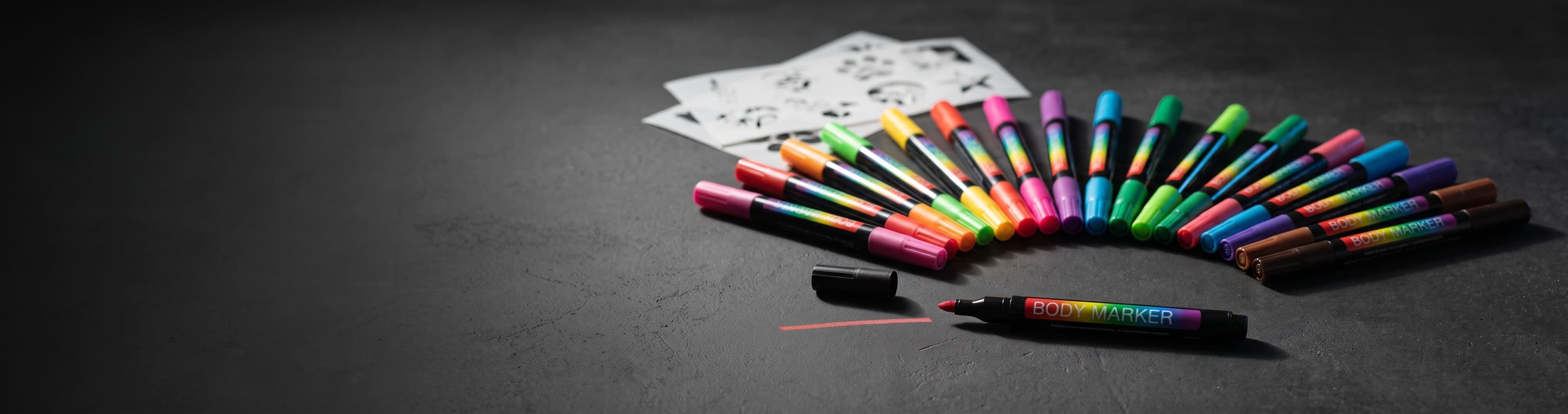
Most temporary tattoo markers smudge within the first hour. You draw something on your arm, it looks great for about twenty minutes, and then you lean on a table or brush against someone and the whole thing turns into a coloured streak. That's not the marker failing — that's a formula designed for paper being sold as a skin product.
Cosmetic Grade Is The Only Grade
The phrase "skin safe" appears on every marker box and means almost nothing by itself. What matters is whether the ink formula is actually cosmetic-grade — meaning it's formulated to sit on skin without absorbing, irritating, or clogging pores.
Craft markers rebranded as body markers are the biggest problem in this category. They use solvent-based ink that's designed to soak into porous surfaces, which is the opposite of what you want on skin. The ink bleeds into pore structure, looks muddy within minutes, and is genuinely difficult to remove.
Real cosmetic-grade ink sits on the surface, dries to a film, and comes off with soap or makeup remover without taking a layer of skin with it.
Tip Shape Decides What You Can Draw
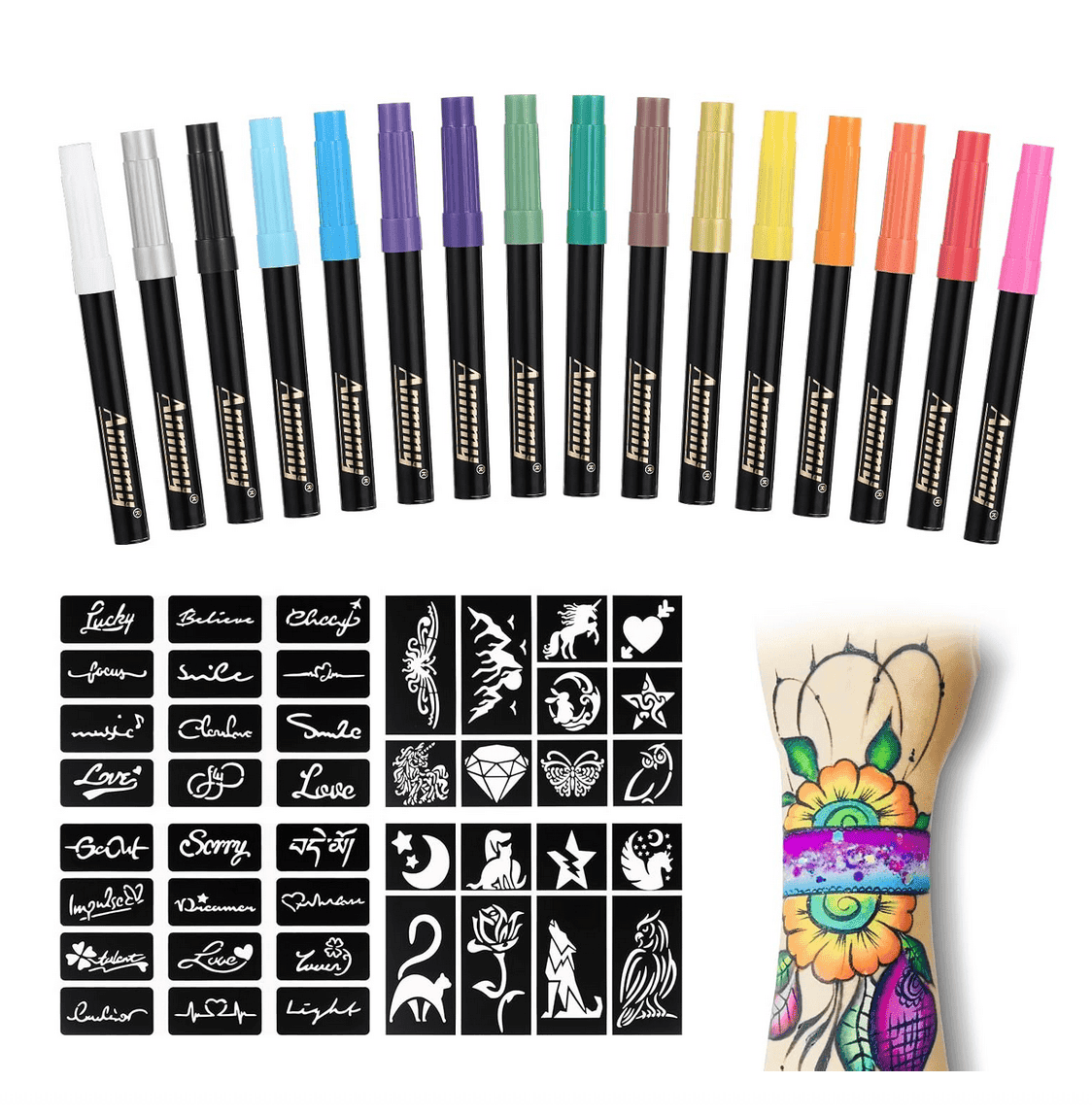
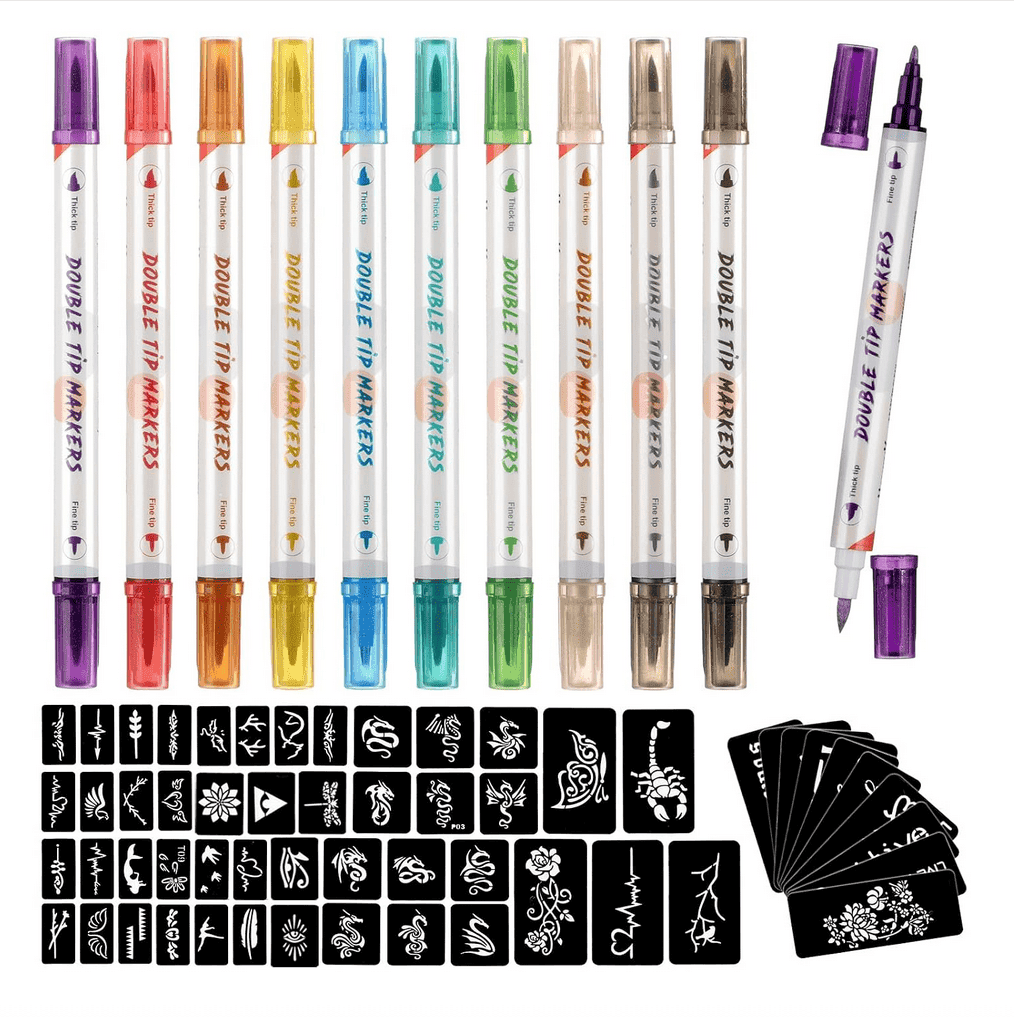
A fine point gives you lines and detail. A broad tip gives you fills and colour blocking. Most people need both, and the cheapest solution is a dual-tip marker rather than buying two separate sets.
"The marker tip is your needle in this world — a broad brush can't do linework and a fine point can't fill a stencil, and most kits only give you one."
Single-tip markers with a precision point are better for freehand work — portraits, script, fine patterns. Stencil-based kits need a broader tip because you're filling shapes, not drawing them. Know which one you're doing before you buy.
Stencils Are Worth More Than You Think
Freehand drawing on skin is a completely different skill from drawing on paper. The surface curves, the texture grabs differently, and you can't erase. Stencils remove that learning curve entirely and let anyone produce clean-looking body art in minutes.
The kits that include stencils are genuinely the better value for parties, events, and anyone who isn't already confident drawing on skin freehand.
What These Markers Can't Do
They can't replicate a real tattoo. The colour sits on the epidermis and no amount of pressing harder will change that — it's surface decoration, not pigment in the dermis. Under heavy sweating, prolonged water exposure, or friction from tight clothing, even the best formula breaks down.
They also won't last the same way on every skin type. Oily skin breaks the film faster, dry skin holds it longer, and hairy areas won't take clean lines no matter what tip you use. Shaving or wiping the area with alcohol before drawing helps, but it's never going to look like ink under skin.
Think of these markers like chalk on a blackboard. The good chalk holds a line and stays put until you wipe it. The cheap chalk crumbles on contact and dusts everything around it. Same tool, different experience.
The Ranked List
DISCLOSURE: This post contains affiliate links. If you purchase through our links we may earn a small commission at no extra cost to you.
1 — JIM&GLORIA FACE PAINT TATTOO PEN
BEST OVERALL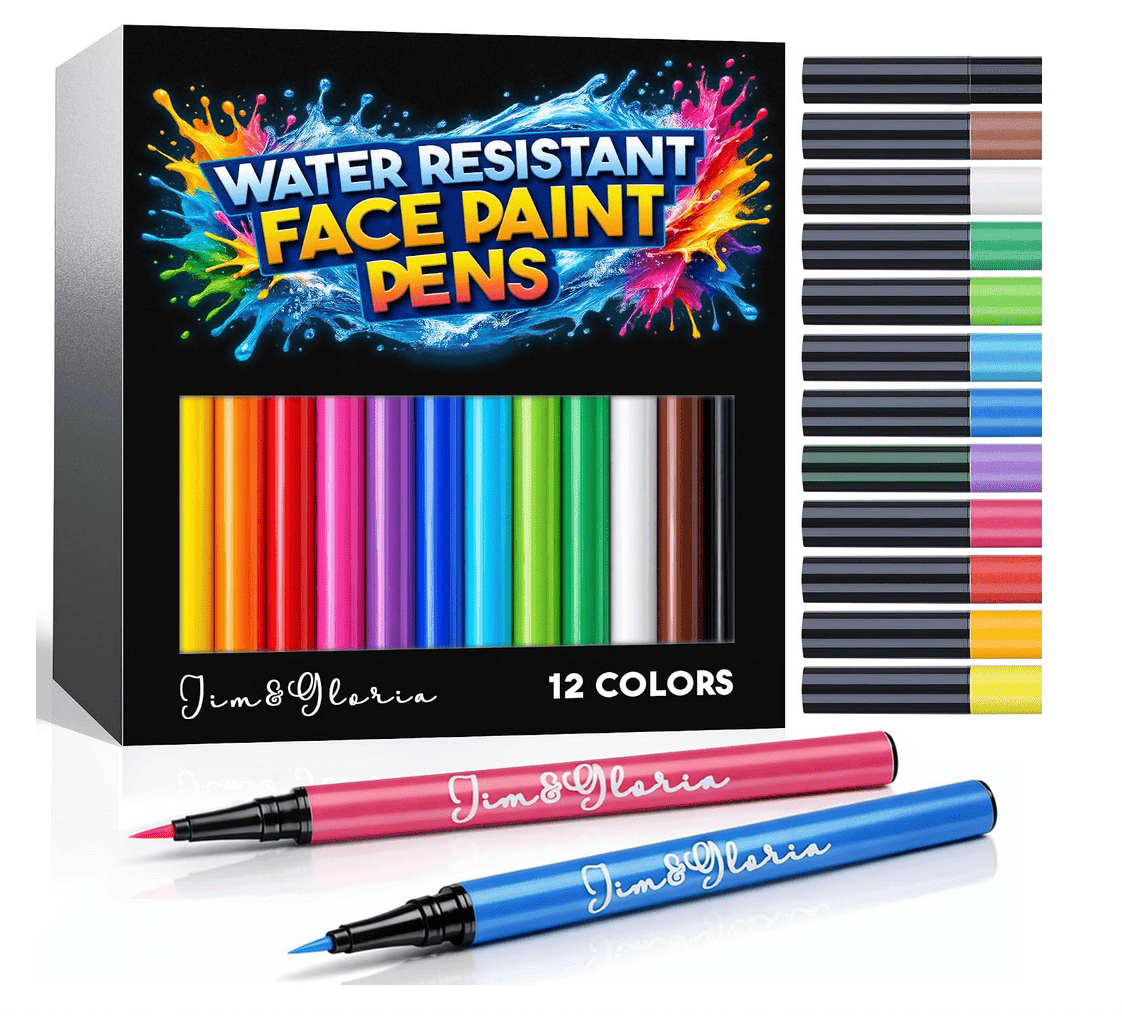
Twelve colours and every one of them goes on vivid rather than watery. The precision tip is genuinely fine — you can pull a clean thin line without the ink pooling or feathering at the edges. It dries in under a minute and stays put through sweat without getting sticky, which is the thing most competitors fail at. Washes off with soap and warm water, no scrubbing required.
No stencils included, so you're drawing freehand — if you can't draw on skin confidently, you'll wish you'd bought a kit with templates.
WHY COSMETIC INK SITS ON SKIN INSTEAD OF SINKING
The outer layer of your skin — the stratum corneum — is a wall of dead cells held together by a lipid matrix. Its whole job is keeping foreign molecules out. Cosmetic-grade body marker ink is formulated with film-forming polymers that dry into a thin, flexible layer on top of this barrier rather than penetrating it. The pigment particles are suspended in a water-based carrier with quick-evaporating solvents, so the carrier flashes off and the polymer film sets within about 30 seconds. That film is what makes the colour smudge-resistant — it's not the pigment clinging to skin, it's a transparent coating locking the pigment in place on the surface. Craft markers and permanent markers work differently. Their solvents are designed to carry dye molecules into porous substrates, and skin is porous enough to absorb them. The dye sinks into the stratum corneum and becomes much harder to remove — soap won't reach it, and you end up scrubbing with alcohol or exfoliating to get the stain out. This is why non-cosmetic markers leave a ghost mark that lasts days after the colour is gone. The formulation difference isn't about pigment quality — it's about whether the carrier is designed to sit on a surface or sink into one.
"The marker tip is your needle in this world — a broad brush can't do linework and a fine point can't fill a stencil, and most kits only give you one."
Already have your design? Each design in our library includes the recommended aftercare protocol for its specific style and placement. Browse verified designs →
Exactly What To Do, Day by Day
CLEAN AND DRY THE SKIN FIRST
Wipe the area with rubbing alcohol or a makeup prep wipe to remove oil. Oily skin is the number one reason markers smudge early, and a ten-second wipe doubles your wear time.
PLACE THE STENCIL AND PRESS FLAT
Smooth any bubbles and make sure every edge sits tight against the skin. A lifted edge lets ink bleed underneath and ruins the line.
FILL BEFORE YOU DETAIL
Use the broad tip to block in colour inside the stencil first. Let it dry completely — at least 60 seconds — before peeling the stencil off and adding fine lines with the precision tip.
LET EACH LAYER DRY FULLY
Layering wet ink over wet ink is how you get muddy colour. Patience between layers is the single biggest difference between a clean result and a smudged one.
SET WITH TRANSLUCENT POWDER OR HAIRSPRAY
A light dusting of translucent setting powder or a quick spray of hairspray from arm's length seals the film and adds an extra hour or two of wear time. Don't overdo it — a heavy coat cracks.
What To Never Use
Permanent markers or Sharpies on skin
the solvent carries dye into the stratum corneum where soap can't reach it, and the ghost stain lasts days after the colour fades.
Craft markers relabelled as body markers
solvent-based ink designed for paper bleeds into skin pores, looks muddy, and is hard to remove cleanly.
Markers with no cosmetic-grade labelling
if the packaging doesn't explicitly state cosmetic-grade or skin-safe formulation, it probably isn't.
Drawing on freshly moisturised skin
lotion creates a slick layer that prevents the film-forming polymer from setting, and the ink slides off within minutes.