Almost every beginner buys a machine on the spec sheet. They compare RPM figures, count the stroke settings, read the battery numbers, and pick whichever bar chart looks biggest. Then they line something at eight volts, blow it out, and spend six months assuming the problem is their hand. Sometimes it is. Often it's a machine running harder than the work needed.
Stroke Length Beats Everything Else
Stroke is the distance the needle travels on every cycle, and it's the single setting that changes how your machine behaves. Short stroke around 2.4 to 3.0mm hits fast and soft — that's lining and fine line work. Long stroke past 3.6mm hits slower and harder, which is what packs colour.
Run a long stroke for fine lines and you'll shred the skin. Run a short stroke for solid black and you'll go over the same area five times trying to get saturation.
That's why adjustable stroke matters more than any RPM figure on the box.
Weight Is What Kills You
A pen machine sits between your fingers all day, and every gram is amplified by the fact that your hand is doing precision work while holding it. Two hundred grams sounds like nothing. It stops sounding like nothing around hour three.
"A wireless machine puts the battery in your hand — you traded the cord for weight, and by hour four your wrist knows which one it prefers."
Balance matters as much as total weight. A machine with the battery stacked on top is top-heavy, and you compensate by gripping harder, which is exactly how you end up with a sore hand and shaky lines late in a session.
Wireless Costs More Than Money
Cordless is genuinely better to work with. No cord dragging across the client, no snagging on the arm rest, no tethering yourself to the power supply.
But you're paying for it in weight, in charge management, and in the fact that batteries degrade. A corded machine with a good power supply gives you completely stable output forever and never needs charging. For learning, that's not a downgrade — that's one less variable.
What The Machine Can't Fix
A good machine makes clean work easier. It does not make clean work happen.
Depth, angle, speed, and stretch are all you, and no motor compensates for pushing too hard or moving too fast. Most blowouts blamed on machines are technique. And if your lines wobble, buying a better pen almost never fixes it — hours on practice skin do.
Think of it like a chef's knife. A sharp one makes good technique easier and bad technique more dangerous. The knife was never the skill.
The Ranked List
DISCLOSURE: This post contains affiliate links. If you purchase through our links we may earn a small commission at no extra cost to you.
1 — MAST FOLD PRO WIRELESS KIT
BEST OVERALL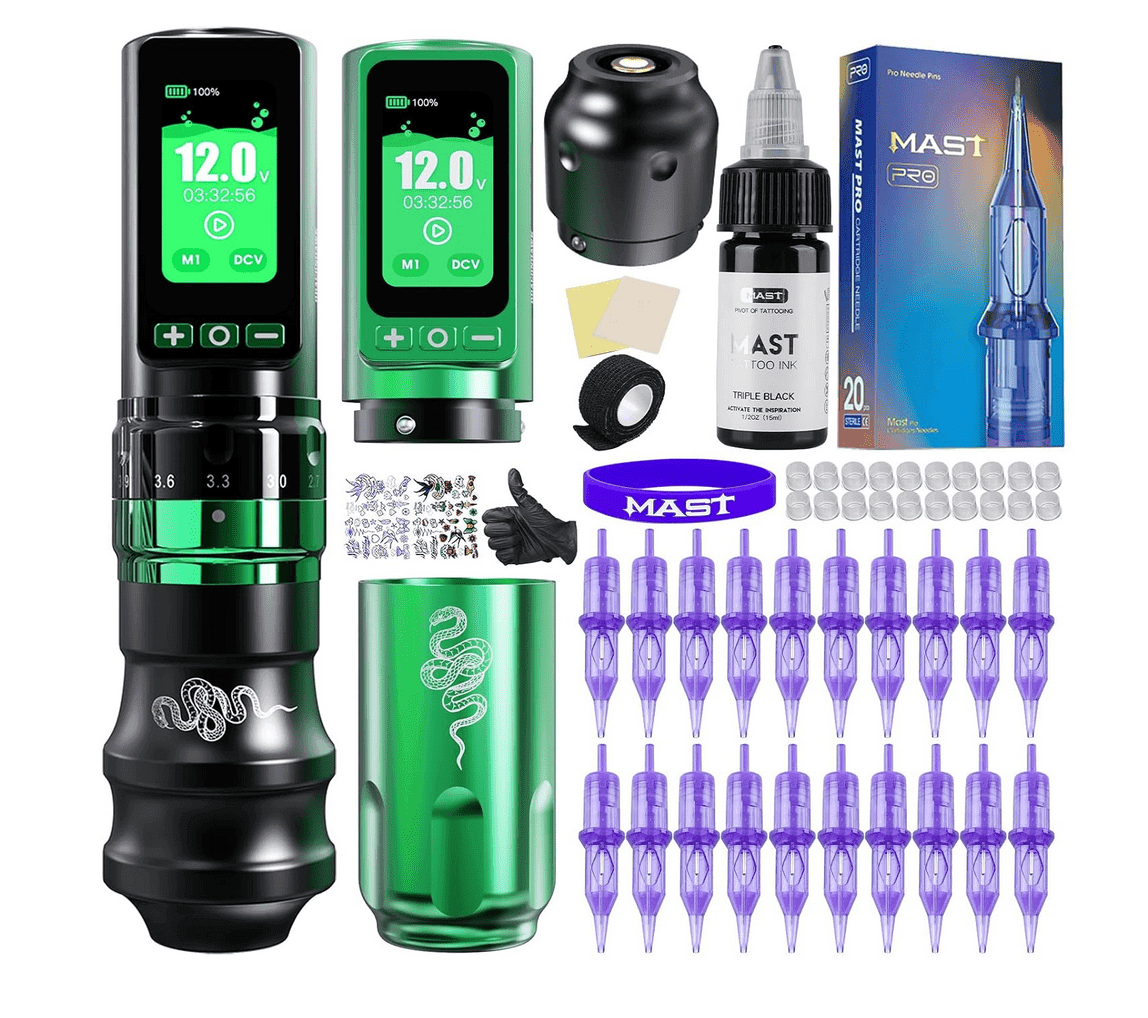
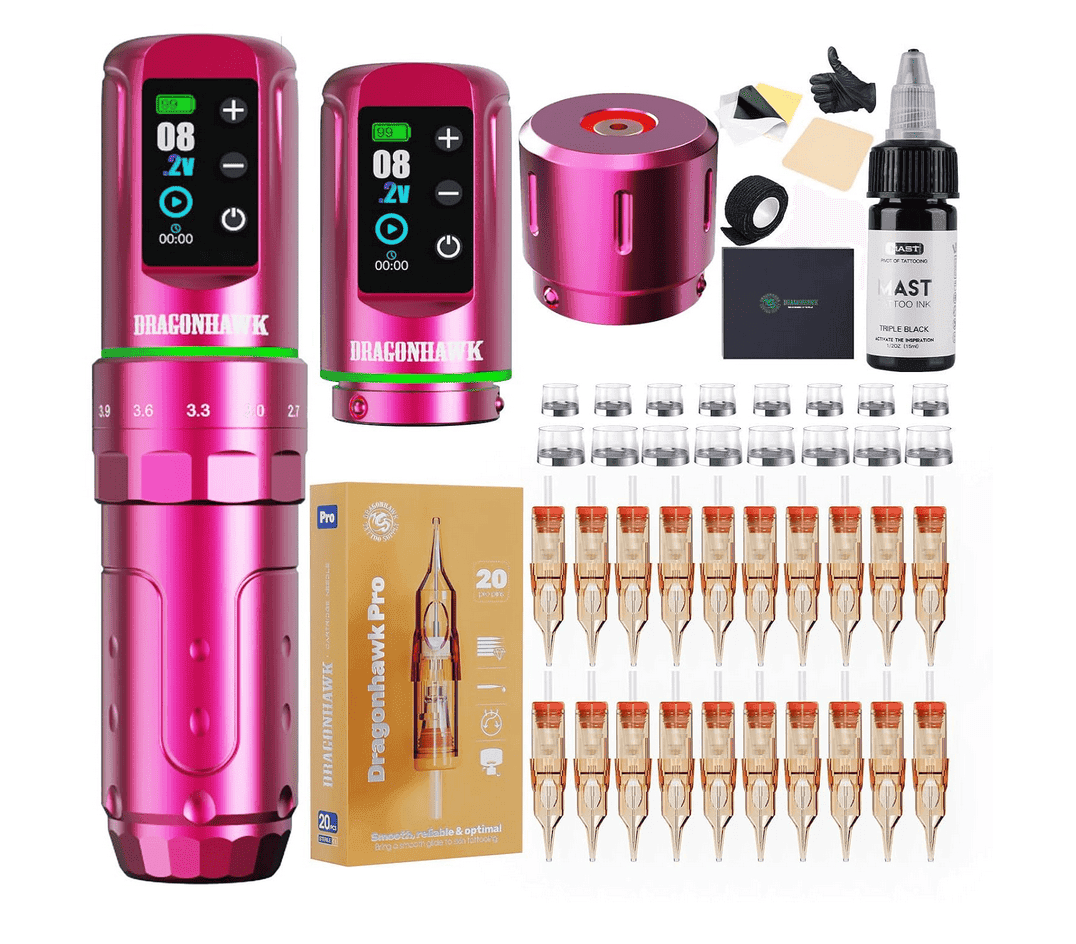
The Mcore-C3 runs quieter than you expect and the vibration through the grip is genuinely low, which is the thing you notice after a long session rather than in the first ten minutes. The stroke dial adjusts on the machine without tools, so you can move from lining to packing mid-session without swapping anything. Two 3000mAh batteries that hot-swap means you never stop working, and the pen stays cool through a full day.
You're paying double the Dragonhawk for a motor refinement most artists won't feel until they've got a year of hours behind them.
HOW STROKE LENGTH CONTROLS SKIN TRAUMA
A rotary machine converts spinning motion into linear needle travel through a cam. The offset on that cam is your stroke length, and it determines two things at once: how far the needle travels, and how much force it lands with. A longer stroke means the needle covers more distance per cycle, arrives with more momentum, and drives deeper into the dermis. That's why long stroke packs colour efficiently — it's depositing more pigment per pass with fewer passes. It's also why long stroke destroys fine line work, because that same force punches past the shallow dermal layer where a crisp line lives and spreads pigment sideways into surrounding tissue. That lateral spread is a blowout. Voltage is the other half. Voltage sets motor speed, which sets how many times per second that needle cycles, and running high voltage to force saturation is the most common self-inflicted problem in tattooing. More hits per second on the same patch of skin means more mechanical trauma, more inflammation, more fluid, and more aggressive pigment clearance while it heals. The tattoo looks bold on the day and heals patchy three weeks later because the skin was overworked. The right combination is almost always a stroke matched to the technique and the lowest voltage that still deposits cleanly — not the highest voltage the machine will take.
"A wireless machine puts the battery in your hand — you traded the cord for weight, and by hour four your wrist knows which one it prefers."
Already have your design? Each design in our library includes the recommended aftercare protocol for its specific style and placement. Browse verified designs →
Exactly What To Do, Day by Day
SET STROKE TO THE TECHNIQUE FIRST
Dial 2.4 to 3.0mm for lining, 3.0 to 3.6mm for shading, 3.6 to 4.2mm for packing. Set this before you touch the voltage, not after.
START LOW ON VOLTAGE AND CLIMB
Begin around 6V and raise it only until the needle deposits cleanly on practice skin. Whatever number gets the job done is the right number.
SEAT THE CARTRIDGE AND CHECK THE THROW
Push the cartridge fully home and run the machine to watch the needle travel before it goes near skin. A loose cartridge rattles and hits inconsistently.
LET THE MACHINE DO THE WORK
Guide the pen, don't press it. Pressure is what causes blowouts, and every gram you add is trauma the skin has to heal.
WIPE THE MOTOR HOUSING AND STORE IT DRY
Clean the grip and housing after every session and never soak a pen machine. Store it out of the case lid pressure with the battery removed if you won't use it for a week.
What To Never Use
Machines with no stroke adjustment
you're locked into one technique and you'll fight the machine on everything else.
Unbranded generic power supplies
unstable voltage output means inconsistent needle depth, which shows up as patchy healing you'll blame on yourself.
Cranking voltage to force saturation
high speed on the same patch of skin causes trauma, and the tattoo heals lighter than it looked on the day.
Sub-thirty-dollar full kits with ink included
the machine is usually the only usable part, and the ink and needles are not worth the risk on real skin.