DISCLOSURE: This post contains affiliate links. If you purchase through our links we may earn a small commission at no extra cost to you.
Good news up front: temporary tattoos are supposed to come off, and they will. Unlike real ink, which sits deep in your skin and needs a laser, temporary designs rest on the surface — so removal is a two-minute job with things you already own, provided you match the method to what you're actually removing.
First, Know Which Type You Have
Removal depends entirely on the type, so start here. Using the wrong method is why people end up scrubbing raw skin and getting nowhere.
- Transfer/decal tattoos — the classic kids' kind applied with water. Sit on the surface as a thin film. Come off very easily.
- Semi-permanent transfers (e.g. "two-week" tattoos) — printed with an ink that stains the top skin layer and fades over one to two weeks. More stubborn than decals but still surface-level.
- Pen, marker, or eyeliner "tattoos" — drawn on directly. Lift with oil or alcohol readily.
- Henna — a paste that stains the upper skin an orange-brown. Genuinely temporary but can't be instantly removed; it fades as your skin naturally sheds, usually one to three weeks.
- "Black henna" — not true henna, and the exception that matters. Covered in its own section below because it's a safety issue, not just a removal one.
- Airbrush tattoos — sprayed-on ink, surface-level, come off with oil or alcohol.
Match your method to your type and removal is quick. Fight the wrong battle and you'll just irritate your skin.
"Temporary" covers a genuinely wide range, and the marketing blurs it, which trips people up. A water-transfer decal wipes off in seconds; a semi-permanent "two-week" tattoo is designed to resist exactly that and will fade on its own timeline no matter what you do; henna is a stain you largely have to wait out. If a design isn't coming off with gentle effort, that usually means it's a fade-over-time type rather than a wipe-off type — and the answer is patience and mild fading help, not harder scrubbing.
The Safe Methods, Easiest First
Work from gentlest to strongest, and stop as soon as one works.
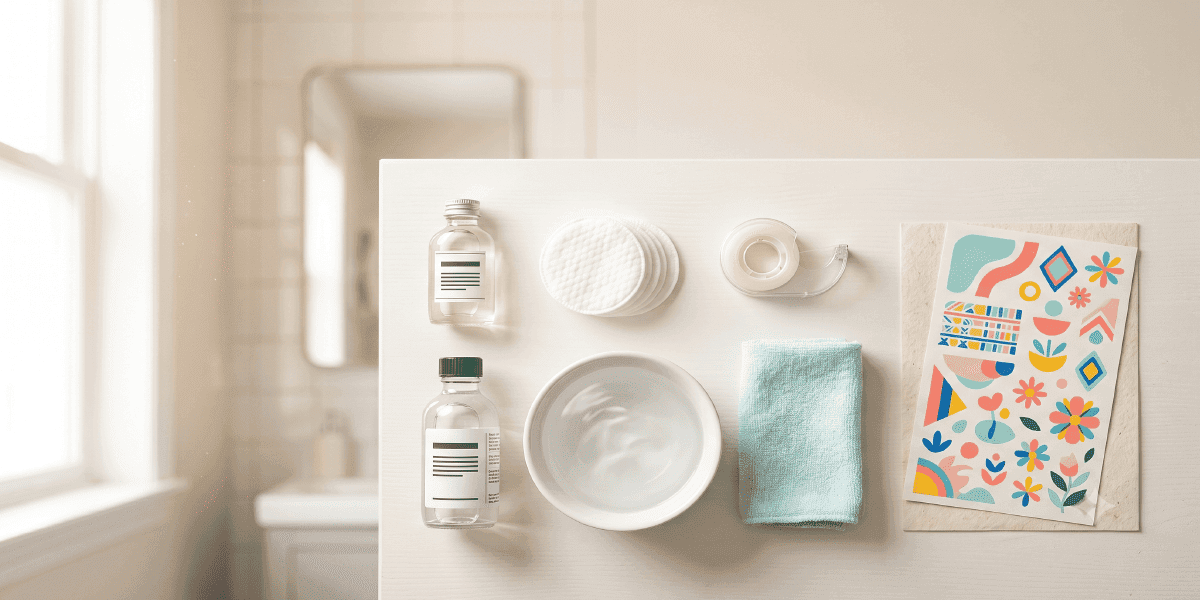
Oil — the first thing to try. Baby oil, coconut oil, olive oil, or any cooking oil. Saturate a cotton pad or your fingers, press onto the tattoo for 30 to 60 seconds to let it break down the film, then wipe firmly. Repeat if needed. This alone removes most transfer, airbrush, and pen tattoos, and it's gentle enough for anywhere including near the face.
Rubbing alcohol — for stubborn spots. Isopropyl alcohol on a cotton pad dissolves inks the oil didn't. Wipe over the design, give it a few passes, and follow with moisturiser because alcohol dries the skin. Good for semi-permanent and pen tattoos.
Adhesive tape — for fresh decals. Press a piece of tape (packing or sticky tape) onto a fresh transfer and peel it away; it lifts the film with it. Repeat over the area. Simple and effective for the classic decal type.
Exfoliation — for lingering stain. Once most is gone, a gentle scrub with a washcloth or mild exfoliant helps clear the last faint residue by speeding up surface skin shedding. Gentle is the word — this is a nudge, not a scrub-down.
Makeup remover or micellar water — the mild all-rounder. Designed to lift surface pigment from delicate skin, so it works well on lighter temporary tattoos and is safe near the eyes.
Whichever you use, moisturise afterward — every one of these strips some natural oil from your skin.
Harder scrubbing is not a stronger method, and treating it as one is the main way people hurt themselves removing something harmless. Aggressive scrubbing with abrasive scrubs, rough pads, or repeated alcohol passes irritates and can break the skin, causing redness, rawness, or even a mild chemical burn — over a tattoo that would have wiped off with oil or faded on its own in a week. If gentle methods aren't working, the design is a fade-over-time type, and the correct response is to wait, not to escalate the abrasion. You can damage real skin trying to force off a fake tattoo.
Henna — You Mostly Wait It Out
Real henna (mehndi) is a plant paste that stains the upper layers of your skin orange-brown, and it's genuinely temporary — but it works by staining, not sitting on top, so you can't wipe it away like a decal.
It fades as your skin naturally sheds, typically over one to three weeks, darker on thick-skinned areas like hands and feet and faster where skin turns over quickly. To gently speed the fade:
- Exfoliate regularly — the stain lives in the cells your skin is already shedding, so gentle exfoliation nudges it along.
- Soak and moisturise — warm water soaks plus consistent moisturising support natural turnover.
- A little lemon juice or a gentle whitening toothpaste on the area can marginally lighten the stain, but go easy and stop if it irritates.
- Swimming — chlorinated pool water tends to fade henna faster, a handy side effect if you're swimming anyway.
Mostly, though, it's patience. True henna is safe and simply on its way out on its own schedule.
There's no instant fix for henna and anyone promising one is selling you irritation, so it's worth setting the expectation honestly. Because it's a stain in the skin rather than a film on top, the only genuine removal is your skin renewing itself, which takes the time it takes. Aggressive attempts to strip it faster damage your skin without meaningfully beating your body's natural shedding rate. If you have an event, the realistic move is to lighten it gently and cover the rest with clothing or makeup, not to scrub it raw the night before.
The One Exception: "Black Henna" Is a Safety Issue
This is the part that actually matters for your health, not just your appearance.
"Black henna" is not true henna. To make henna appear black and stain faster, some products add PPD (para-phenylenediamine), a chemical dye also used in hair colour. On skin, especially at the high concentrations used in black henna, PPD can cause severe allergic reactions — intense itching, blistering, painful chemical burns, and permanent scarring, sometimes in the exact shape of the design. Reactions can appear during the stain or days later, and once you're sensitised to PPD, you can react badly to it for life, including to ordinary hair dye.
If you have a black henna tattoo and your skin is reacting — redness, itching, blistering, raised or weeping skin:
- Don't try to scrub or chemically remove it — that worsens the reaction.
- Wash the area gently with mild soap and water to remove residual product.
- See a doctor or pharmacist, especially for blistering or spreading reaction. This may need medical treatment like topical steroids.
- Note that you may now be PPD-sensitive and mention it before any future hair dye or dark henna.
This is the one place in an otherwise trivial topic where the honest advice is "this can genuinely harm you," and it deserves to be stated without softening. Black henna reactions are real, documented, sometimes severe, and capable of leaving permanent scars — which is a bitter irony for something marketed as temporary. If you're choosing a temporary tattoo, avoid black henna entirely; if you already have one and your skin is reacting, this stops being a removal question and becomes a medical one. When in doubt about any skin reaction, a doctor beats a home method every time.
Think of temporary tattoo removal like getting a sticker off a window versus a stain out of a cloth. The sticker — your decals, pen, and airbrush — peels or wipes away with the right solvent in seconds, and forcing it just scratches the glass. The stain — henna — is soaked in, and no amount of scrubbing beats simply waiting for it to wash out over time. Know which one you've got, use the gentle right tool, and leave the harsh scrubbing out of it entirely.
Related Studio & Technical Guides
- Needle Configuration: Understand taper & groupings in our Best Tattoo Needles Guide.
- Machine Setup: Compare starter rotary options in our Best Tattoo Machine for Beginners Guide.
- Hygiene Standards: Review barrier controls in our Best Tattoo Grip & Supply Guide.
WHY SURFACE INK LIFTS BUT STAINS MUST FADE
The reason temporary tattoos come off so much more easily than real ones is entirely about depth, and the different types divide cleanly into two mechanisms. Transfer decals, airbrush ink, and pen tattoos sit as a thin film on the surface of the epidermis, the outermost layer of skin, held there by a weak adhesive or by the ink's own surface binding. Nothing anchors them into living tissue, so they yield to simple chemistry: oils dissolve the oil-based binders and adhesives, and alcohol dissolves many pigments directly, lifting the whole film away without touching the skin underneath. This is why the gentlest solvent usually wins and why force adds nothing — you're not fighting an anchor, you're dissolving a coating, and once the binder breaks the film simply wipes off. Henna works by a fundamentally different mechanism, which is why it can't be wiped away. The active molecule in henna, lawsone, penetrates into the upper layers of the epidermis and binds chemically to keratin, the structural protein in your skin cells, forming a genuine stain within those cells rather than a film on top. Because the pigment is now inside cells that are part of your skin's structure, the only way it leaves is with those cells — and your epidermis renews itself continuously, shedding its outer cells and replacing them from below over roughly two to four weeks. That turnover rate is what sets henna's fade time; exfoliation helps only because it accelerates the shedding of those already-stained surface cells, and it can't outrun the biology by much. "Black henna" is more dangerous precisely because PPD doesn't just stain — it's a reactive chemical that can bind to skin proteins and trigger the immune system, producing an allergic contact dermatitis that no removal method addresses, because the problem isn't pigment sitting somewhere but an immune reaction already underway in the tissue.
"Harder scrubbing isn't a stronger method — it's how people give themselves a chemical burn removing something that would have wiped off with baby oil."
Exactly What To Do, Day by Day
IDENTIFY WHICH TYPE OF TEMPORARY TATTOO YOU HAVE
Decals, pen, and airbrush sit on the surface and wipe off; semi-permanent transfers and henna are stains that fade over time. Matching the method to the type prevents pointless scrubbing.
START WITH OIL AND ONLY ESCALATE IF NEEDED
Press baby, coconut, or olive oil onto the design for 30 to 60 seconds, then wipe firmly. This removes most surface tattoos; move to rubbing alcohol on a cotton pad only for stubborn residue.
USE TAPE FOR FRESH DECALS AND GENTLE EXFOLIATION FOR RESIDUE
Press and peel tape to lift a fresh transfer film, and use a mild exfoliant or washcloth to clear the last faint traces once most is gone. Keep it gentle — a nudge, not a scrub-down.
WAIT OUT HENNA WITH GENTLE FADING HELP
Real henna fades over one to three weeks as your skin sheds, so support it with regular exfoliation, soaking, and moisturising rather than trying to strip it instantly. There is no safe instant removal for a stain.
TREAT A REACTING BLACK HENNA TATTOO AS MEDICAL NOT COSMETIC
If skin under a black henna design is itching, blistering, or raised, stop all removal attempts, wash gently, and see a doctor or pharmacist. Note possible PPD sensitivity before any future hair dye.
What To Never Use
Scrubbing hard with abrasive pads or repeated alcohol passes
it irritates and can break or chemically burn skin over a tattoo that would have wiped off gently or faded on its own.
Trying to instantly strip henna
it's a stain inside your skin cells that only leaves as the skin sheds, so aggressive attempts damage skin without beating your natural turnover.
Attempting to scrub or chemically remove a reacting black henna tattoo
that worsens the PPD allergic reaction, which needs gentle washing and medical care, not removal.
Using harsh solvents near the eyes or on broken skin
reach for makeup remover or micellar water in delicate areas, and stop any method that causes redness or rawness.