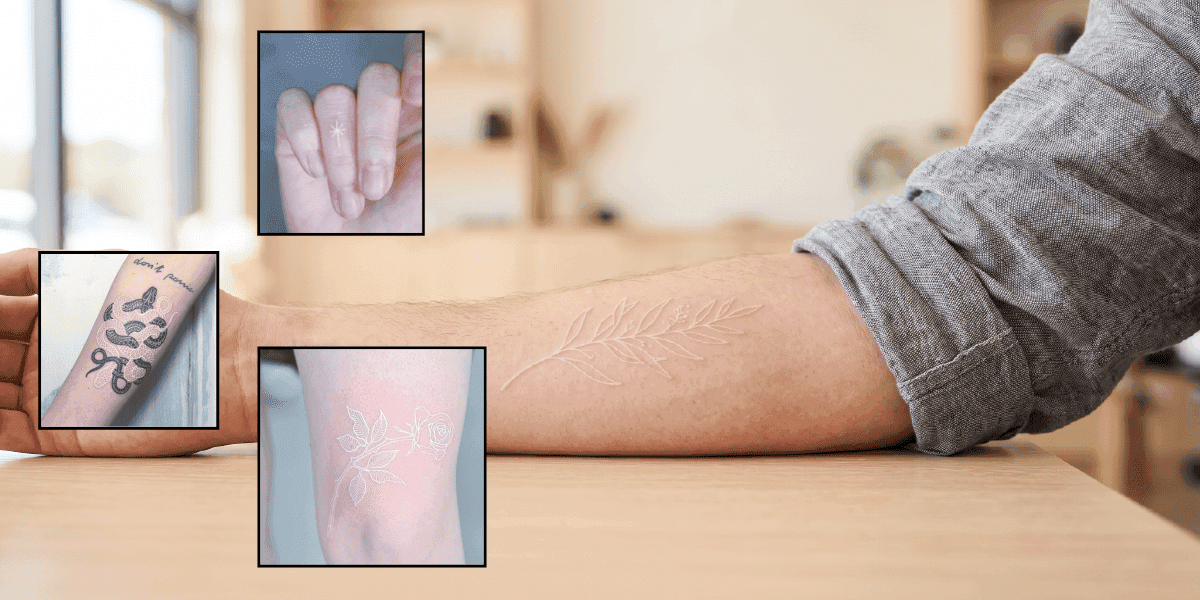
White Ink Tattoos: Why They Fade and What to Expect
FAQ & How-To7 MIN READ
White Ink Tattoos — Why They Fade and What to Expect
White ink fades, yellows, and blurs faster than any colour — the online photos are day one. Why it happens, who it suits, and how to decide honestly.
By TattoosMap Editorial — August 2026
The Short Answer
White ink tattoos fade because white pigment is less dense and more translucent than dark ink, sits under skin that has its own tone, and is easily discoloured by sun and healing — so they blur, yellow, or fade to a faint scar-like mark within months to a few years. They work best on very fair skin as subtle, simple designs, and poorly on darker skin or for fine detail. Go in expecting a soft, impermanent, unpredictable result rather than the crisp glowing white in online photos, and choose an artist experienced specifically with white ink.
DISCLOSURE: This post contains affiliate links. If you purchase through our links we may earn a small commission at no extra cost to you.
The white ink tattoo you saved on Pinterest — crisp, glowing, delicate as lace on skin — is real, but it's also the exception that got photographed at its best moment.
What the picture doesn't show is that same tattoo six months later. White ink is the most beautiful and most disappointing choice in tattooing, and the honest version of the story is worth hearing before you commit.
Why White Ink Fades So Much Faster
Every tattoo fades over time, but white ink fades faster, less predictably, and often less gracefully than any other colour. Several things stack up, all working against it:
White pigment is less dense and more translucent — where black is opaque and bold, white is see-through, so it reads faintly from the start and any fading pushes it toward invisible sooner
Your skin tone shows through it — white isn't opaque enough to mask the skin beneath, and as it thins, the skin shows through more, muddying the white
It discolours easily — highly prone to yellowing and dulling from sun, healing, and interaction with skin, so white turns cream, yellow, or grey
Sun destroys it — UV breaks down all pigment, but white's translucency means the damage shows far faster
It sits shallow and subtle by nature — the soft close-to-skin look is the appeal, but that subtlety makes any fading immediately obvious
HONEST LIMITATION
No artist and no technique fully overcomes these — the fading is a property of the pigment, not a fixable mistake.
A skilled artist experienced with white ink gets a better, longer-lasting result than a novice, with deeper, more even packing and the right candidate and design. But even the best white ink tattoo fades faster and less predictably than a standard black one.
"If someone promises you a permanently crisp, bright white tattoo that stays like the photo, they're overselling."
The realistic promise is a soft, subtle result that will change and fade, done as well as the pigment allows.
What White Ink Actually Looks Like Over Time
Setting honest expectations means knowing the range of how these age, because it's wide and often not what people picture.
WHY WHITE PIGMENT CAN'T STAY OPAQUE IN SKIN
The behaviour of white ink comes down to the optics of how pigment sits in living skin, and white is at a fundamental disadvantage. All tattoo ink is deposited in the dermis, below a translucent layer of epidermis, so every tattoo is effectively viewed through a thin veil of your own skin. Dark pigments like black cope with this because they're opaque and absorb light strongly — even seen through the epidermis, black reads as black because it reflects almost no light back. White pigment works in the opposite way: it creates its colour by reflecting and scattering light rather than absorbing it, and to read as bright, solid white it needs to be dense and opaque enough to bounce back light while masking everything beneath it. In skin, it rarely achieves that opacity. The pigment is more translucent than black, it's deposited in a thinner, less dense layer, and it sits over the varied colours of your own dermis and its blood supply. So instead of reflecting pure white, it lets your underlying skin tone show through and mix in, which is why white ink reads faintly and takes on the cast of the skin beneath it from the very start. Fading and discolouration then compound this optical weakness. Over time, all tattoo ink is gradually broken down and dispersed by the immune system and diluted as skin cells turn over, thinning the pigment layer — and because white was barely opaque enough to begin with, even modest thinning pushes it toward transparency far sooner than it would a bold dark ink. White pigment is also chemically prone to discolouration: it yellows and dulls in response to UV exposure, oxidation, and interaction with the surrounding tissue, so the colour itself degrades from white toward cream, yellow, or grey even where pigment remains. The scar-like appearance many white tattoos develop comes from this same translucency — once the colour has faded and dulled, what remains visible is often the subtle textural change of the tattooed skin itself rather than the pigment, so the design reads as a raised relief rather than a drawn line. Every one of these effects traces back to the same root cause: white creates colour by reflecting light it can't reliably reflect through skin, where black creates colour by absorbing light it absorbs easily regardless of the veil above it.
SHARE THIS
"The crisp glowing white tattoo online is the day-one photo — six months later, white ink often reads more like a faint raised scar than a drawing."
FROM TATTOOSMAP
Already have your design? Each design in our library includes the recommended aftercare protocol for its specific style and placement. Browse verified designs →
Exactly What To Do, Day by Day
01
JUDGE WHITE INK ON HEALED PHOTOS OVER A YEAR OLD
Fresh white ink and general portfolios tell you nothing about how it ages. Ask your artist specifically for healed white ink work at least a year old to see the honest result.
02
MATCH THE CHOICE TO YOUR SKIN TONE HONESTLY
White ink reads truest on very fair skin and poorly on medium-to-deep tones, where the skin shows through and it looks ashy or faint. If you have darker skin, accept this or consider alternatives.
03
KEEP THE DESIGN SIMPLE AND BOLD
Minimal shapes and thicker lines survive fading far better than fine intricate detail, which blurs and disappears fastest. Choose a design that can afford to soften.
04
ACCEPT IMPERMANENCE AND PLAN FOR TOUCH-UPS
Go in expecting the tattoo to fade, yellow, and change, and expecting to need touch-ups. If permanence and crispness matter to you, white ink is the wrong choice.
05
PROTECT IT FROM THE SUN RELENTLESSLY
UV is the biggest accelerant of white ink fading and yellowing that you control. Keep it covered or well protected, and choose placement away from high-sun, high-friction areas.
What To Never Use
Expecting white ink to stay crisp and bright like the online photos
those are day-one best cases, and the pigment's translucency means it fades, yellows, and blurs far faster than any dark ink.
Choosing white ink for detailed or fine-line designs
delicate work blurs and fades fastest, so intricate white tattoos disappoint soonest and read as faint smudges within months.
Getting white ink on medium-to-deep skin without honest expectations
its translucency lets your skin tone dominate, so it reads ashy or faint and fades to near-invisibility, and no artist can overcome that.
Judging a white ink artist on fresh photos
white ink looks its best the day it heals and worst over time, so only healed work over a year old shows whether they can deliver a lasting result.
Frequently Asked Questions
White pigment is less dense and more translucent than dark ink, so it reads faintly from the start and any fading pushes it toward invisible sooner. Your skin tone shows through it, it yellows and dulls easily from sun and healing, and UV breaks it down faster than bold dark ink. These are properties of the pigment, not fixable mistakes.
Commonly they fade toward invisible, yellow or cream, blur, or heal to look like a subtle raised scar rather than a crisp drawing. Because white is so translucent, what you often see over time is the slight textural change of the tattooed skin more than the colour. The bright crisp look in fresh photos is the peak and it's temporary.
Largely no. White ink's translucency means darker skin tones show through strongly, so it reads as a faint, ashy, or greyish mark rather than white and fades to near-invisibility quickly. This isn't something a skilled artist can overcome — it's the pigment's transparency meeting the skin's colour. Honest artists often steer darker-skinned clients toward alternatives.
For the right person, yes — someone with fair skin who wants a subtle, delicate, impermanent, scar-like design and accepts it will fade and change can love it. The disappointment comes from expecting crisp permanence the pigment can't deliver. It's a specific choice for specific expectations, not a bad one, so know which you are before booking.
Choose an artist experienced specifically with white ink, keep the design simple and bold, protect it relentlessly from the sun, place it away from high-sun and high-friction areas, and plan for touch-ups. These help, but even at their best white ink fades faster and less predictably than dark ink, so manage expectations alongside the care.
Discussion (0)
Verified Accounts
No public comments yet.
Find Your Artist
Ready To Book?
Browse verified tattoo artists on TattoosMap — filtered by style, city, and specialty.
Freshly healed, a good white ink tattoo can look like the photos — a subtle, raised, pale design, sometimes with a slight sheen. This is the peak, and it's temporary.
Common Outcomes Over Months to Years
Fading toward invisible — the design becoming faint and hard to see
Yellowing or creaming — the white shifting to an off-white, yellow, or dull tone
A scar-like appearance — reading as a raised relief more than a crisp drawing
Blurring — fine lines and detail spreading and losing definition
Patchiness — uneven fading, with some areas holding and others vanishing
The scar-like quality surprises people most. Because white ink is so subtle, what you often perceive is the slight raised texture of the tattooed skin rather than a bold colour — closer to an embossed mark than a painted one.
HONEST LIMITATION
The "looks like a scar" outcome deserves emphasis rather than a footnote, because it's the opposite of what most people are hoping for.
Some people love this subtle embossed effect and choose white ink precisely for it — that's a valid reason to get one.
"Wanting the subtle look and being disappointed by the subtle look lead to very different satisfaction with the same tattoo."
But if your mental image is a crisp, clearly-readable white design that looks painted on, there's a real chance the healed reality reads more as a faint raised mark. Be honest with yourself about which you actually want.
Who White Ink Works On — And Who It Doesn't
White ink is one of the most candidate-dependent choices in tattooing. It works far better for some people and designs than others.
Works Better For
Very fair skin — the less your skin tone shows through, the closer to true white it reads and stays
Simple, bold designs — minimal shapes and thicker lines survive fading better than intricate ones
A subtle, close-to-skin effect rather than a bold statement
Realistic expectations that accept it as impermanent and changeable
Works Poorly For
Darker skin tones — the skin shows through translucent white much more, reading faintly, tinting toward the skin tone, and looking ashy or barely visible
Fine, detailed designs — delicate linework blurs and fades fastest
Anyone wanting a crisp, lasting, high-contrast result — that's not what white ink delivers
High-sun areas — accelerates the fade dramatically
HONEST LIMITATION
The darker-skin point is one an honest guide has to state plainly: white ink largely does not work well on medium-to-deep skin tones, because its translucency means your skin tone dominates what you see.
This isn't a limitation a skilled artist can overcome — it's the pigment's transparency meeting the skin's colour. On deeper skin, white ink often reads as a faint ashy or greyish mark rather than white, and fades to near-invisibility quickly.
If you have darker skin and want a subtle or pale-looking design, a good artist may honestly steer you toward alternatives rather than promise a white tattoo the pigment can't deliver on your skin.
How to Decide — And Do It Well
If you understand all of the above and still want one, here's how to give it the best chance:
Choose an artist experienced specifically with white ink, and ask to see their healed white ink work over a year old — not fresh photos, not their general portfolio
Keep the design simple and bold — minimal shapes, thicker lines, less fine detail survive
Accept it as impermanent — expect touch-ups and expect the design to fade and change
Protect it from the sun relentlessly — the single biggest thing you control for longevity
Consider placement away from high-sun, high-friction areas
Manage expectations against healed reality, not Pinterest
Some people also consider UV or "blacklight" ink for a similar hidden-until-lit effect, but that's a different pigment with its own significant concerns and isn't a straightforward fix for white ink's issues.
HONEST LIMITATION
It's worth ending by being fair to white ink rather than only warning against it, because for the right person it's a genuinely lovely, deliberate choice.
Someone with fair skin who wants a subtle, delicate, impermanent, scar-like design — and who chooses it knowing it'll fade and change — can be completely happy with white ink.
"The disappointment comes almost entirely from mismatched expectations: people expecting crisp permanence from a pigment that delivers soft impermanence."
White ink isn't a bad tattoo choice; it's a specific one that suits specific people and specific expectations. Know which you are before you book, and it can be the right call.
Think of white ink like writing in pale pencil versus bold marker. The marker — dark ink — stays legible for years and reads clearly from across the room.
The pale pencil is soft, delicate, and lovely up close, but it's faint from the start, smudges more easily, and fades toward the colour of the paper underneath as time passes. Neither is wrong — they're for different purposes. Don't reach for the pencil and feel let down that it isn't a marker. Choose the pencil because the soft, fading, delicate quality is exactly what you want.