Laser Tattoo Removal Machines — What's Actually in the Room, Decoded
Q-Switch or picosecond, PicoWay or PicoSure — what the machines clinics use actually mean, and the four questions that reveal if one can clear your ink.
By TattoosMap Editorial — August 2026
The Short Answer
Clinics mainly use two categories: Q-switched lasers (older, cheaper, nanosecond pulses — good for black, can't clear green) and picosecond lasers like PicoWay and PicoSure (newer, faster, gentler, better on stubborn colours). What matters isn't the brand name but the wavelengths it fires — 1064nm for black, 755nm for green, 532nm for red. Ask what wavelengths the machine has, and if the answer is a brand name with no numbers, they don't know their own equipment.
DISCLOSURE: This post contains affiliate links. If you purchase through our links we may earn a small commission at no extra cost to you.
You'll sit in a chair, sign a form, and let someone point a machine at your skin fifteen times over the next year — and most people never ask what the machine is, or wouldn't know what the answer meant if they did. That's backwards. The device in the room is the single biggest factor in whether your removal works.
The Two Categories That Matter
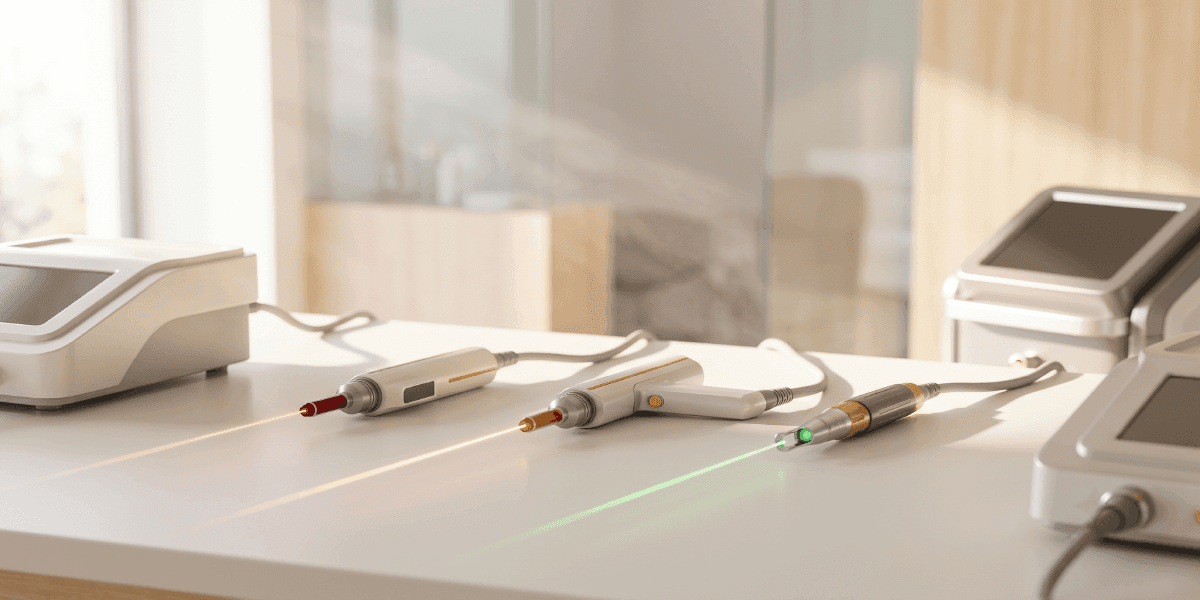
Strip away the brand names and there are two kinds of tattoo removal laser, divided by one thing: how long the pulse lasts.
Q-switched lasers fire nanosecond pulses — billionths of a second. This is the older standard, in use since the 1990s, and it's what most clinics own because it's far cheaper to buy. It clears black and red well, runs hotter on the skin, needs more sessions, and cannot meaningfully clear green or teal.
Picosecond lasers fire pulses a thousand times shorter — trillionths of a second. Newer, more expensive, they shatter ink into finer particles, need fewer sessions, run cooler with less scarring risk, and handle stubborn colours the older machines can't.
That's the whole landscape. Everything else is brand names and configurations layered on top of these two pulse types. Our full pico versus Q-Switch breakdown covers which is worth it for which tattoo.
HONEST LIMITATION
The category tells you the pulse type, not the quality. There's a wide gulf between a well-maintained, properly-calibrated machine in trained hands and a cheap unit run by someone certified over a weekend — in either category. "It's a picosecond laser" is not a guarantee of a good outcome any more than "it's a Q-Switch" is a guarantee of a bad one. The machine sets a ceiling; the operator decides whether you reach it.
Wavelength Is What Actually Matters
Forget the brand for a moment. The number that determines whether a machine can clear your tattoo is its wavelength — because ink only breaks if it absorbs the specific wavelength fired at it.
1064nm — clears black and dark blue. The workhorse. Also the safest wavelength for darker skin, because it passes through melanin rather than being absorbed by it.
WHY ONE MACHINE CAN'T CLEAR EVERY COLOUR
Every pigment has an absorption spectrum — a narrow band of light wavelengths it absorbs while reflecting the rest — and that reflected light is literally the colour you see. Green ink looks green because it reflects the wavelengths around 1064nm and absorbs very little of them. That reflection isn't a minor inefficiency; it's close to a wall. When a 1064nm laser fires at green ink, the pigment sends most of that energy straight back rather than taking it in, so the particle never receives the shock it needs to fracture. This is the physical reason a two-wavelength Q-Switch clears the black around a green tattoo perfectly while leaving the green completely untouched — the black absorbs 1064nm greedily and shatters, the green reflects it and sits there. To break green you have to fire a wavelength green actually absorbs, which is 755nm, and if the machine doesn't have that wavelength, no number of sessions changes the outcome. This is why wavelength coverage, not power or brand, defines what a machine can do. A tattoo with black, red, and green is really three different absorption problems requiring three different wavelengths — 1064nm for the black, 532nm for the red, 755nm for the green — and a machine missing any one of them simply cannot address that colour. It's also why melanin complicates darker skin: melanin is a pigment too, with its own absorption curve that overlaps heavily with the shorter wavelengths like 755nm. On deeper skin tones, a 755nm pulse aimed at green ink is partly absorbed by the melanin in the surrounding skin, turning into heat in living tissue and causing burns or hypopigmentation. The longer 1064nm wavelength sidesteps this because melanin absorbs it weakly, which is why it's the safe choice for dark skin — but 1064nm is also the wavelength green reflects, which is the exact bind that makes green ink on dark skin the hardest problem in the field. None of it is about the machine being powerful or premium. It's about which wavelengths it can physically produce.
SHARE THIS
"A machine can only clear the inks its wavelengths reach — a brand name with no numbers attached tells you nothing about whether it can clear yours."
What To Never Use
Choosing a clinic by brand name alone
two clinics with the same named machine get different results depending on configuration, calibration, and operator, so translate every brand into its wavelengths and pulse type first.
Booking a machine without 755nm for a tattoo with green or teal
those pigments reflect the standard Q-Switch wavelengths, so you'll clear the black and leave the colour permanently untouched.
Accepting aggressive 755nm treatment on Fitzpatrick IV–VI skin
melanin absorbs that wavelength strongly, turning laser energy into heat in living tissue and causing burns and hypopigmentation.
Trusting a tech who can't name their machine's wavelengths
not knowing the wavelengths means not understanding the tool, which is a different and worse problem than simply owning a budget machine.
Frequently Asked Questions
Mainly two categories — Q-switched lasers (older, cheaper, nanosecond pulses, good for black) and picosecond lasers like PicoWay and PicoSure (newer, faster, gentler, better on stubborn colours). The common budget machine is the Q-switched Nd:YAG firing 1064nm and 532nm.
There's no single best — it depends on your ink. PicoWay is the strongest generalist and safest for darker skin, PicoSure is best for green and teal, and a Q-switched Nd:YAG is a cost-effective choice for simple black work. Match the machine's wavelengths to your tattoo's colours.
Ask directly what device they use and what wavelengths it fires. You want specific numbers — 1064, 532, 755 — not just a brand name. If they can't answer instantly, they don't fully understand their own equipment.
755nm, the alexandrite wavelength, which green and teal absorb best. The standard Q-Switch wavelengths of 1064nm and 532nm reflect off green rather than fragmenting it, so a machine without 755nm cannot clear those colours.
Both are essential and neither substitutes for the other. The machine sets a ceiling — it must have the wavelengths your ink absorbs — but the technician's fluence, overlap, and endpoint choices decide whether you reach that ceiling. A great machine set wrong loses to a modest one set right.
Discussion (0)
Verified Accounts
No public comments yet.
TATTOOSMAP VERIFIED CLINICS
Ready To Start?
Get a free consultation quote from a verified removal clinic. No commitment, just a real price for your specific tattoo.
755nm (alexandrite) — clears green and teal, the colours nothing else reliably touches. Unsafe to run aggressively on darker skin because melanin absorbs it strongly.
694nm (ruby) — an older option for green and blue, less common now.
785nm — a picosecond wavelength for blues and greens, gentler than 755nm on darker skin.
A machine can only clear the inks its wavelengths reach. A two-wavelength Q-Switch with 1064nm and 532nm will clear your black and red beautifully and never touch your green — because it has no wavelength that green absorbs. This is the most common and most expensive misunderstanding in tattoo removal.
HONEST LIMITATION
This is the fact clinics with limited machines have a financial reason not to volunteer. A clinic whose only device is a 1064/532 Q-Switch isn't going to lead with "by the way, we can't clear the green in your tattoo" — the honest version of that sentence ends with you taking your money elsewhere. So the responsibility falls on you to ask directly: "What wavelength clears green, and does your machine have it?" If they can't answer cleanly, that tells you what you need to know.
The Brand Names You'll Actually Hear
Clinics advertise by brand, so here's what the common names mean.
PicoWay — a picosecond machine with three wavelengths (532, 785, 1064nm). The best generalist and the safest picosecond option for darker skin, because it leans on 1064nm. Strong on black, capable on most colours.
PicoSure — a picosecond machine built primarily around 755nm. The device to seek out for green, teal, and light blue, which it clears better than anything else. Its 755nm focus makes it a poor and risky choice for Fitzpatrick IV–VI skin.
Q-switched Nd:YAG — the generic budget workhorse, not a single brand. Fires 1064nm and 532nm. Cheap, everywhere, effective on black and red, incapable on green. Many different manufacturers make these.
RevLite, MedLite, Astanza, Quanta, Cynosure, Candela — brand and manufacturer names you may see. Some are Q-switched, some picosecond, some offer multiple configurations. The name alone doesn't tell you the pulse type or wavelengths — you have to ask.
HONEST LIMITATION
Brand names are marketing, and clinics lean on them because "we use PicoSure" sounds more impressive than a spec sheet. But two clinics with the same named machine can get very different results depending on maintenance, calibration, the specific configuration they bought, and above all the operator. Don't be dazzled by a brand you recognise, and don't dismiss one you don't. Translate every brand name into its wavelengths and pulse type, and judge on that.
How to Read the Machine Before You Commit
You don't need to become a technician. You need about four questions and the confidence to ask them.
"What device do you use, and what wavelengths does it fire?" The single most useful question. You want specific numbers, instantly. A brand name with no wavelengths means they don't know their equipment.
"Is it Q-switched or picosecond?" Sets your expectation for session count, cost, and skin comfort.
"Does it have 755nm?" Ask this specifically if your tattoo has any green, teal, or light blue. Without it, those colours won't clear.
"What's the safest wavelength for my skin tone?" For Fitzpatrick IV–VI, the right answer is 1064nm. If they steer you toward aggressive 755nm on dark skin, leave.
Signs the machine or clinic isn't right for you:
No frosting during treatment — the laser isn't reaching your pigment, wrong wavelength or fluence too low
A colour that hasn't moved at all after six sessions — a wavelength problem, not a patience problem
A tech who can't name the wavelengths — they don't understand their own tool
One machine offered as the answer to a full-multicolour tattoo — no single device is best at everything
Even a perfectly-matched, top-tier machine won't rescue a bad operator, and this is the part no spec sheet captures. The tech's choices — how much energy to deliver, how to overlap the pulses, when to stop, how to adjust as your skin responds — matter as much as the wavelengths available. A brilliant machine set wrong is worse than a modest one set right. When you've confirmed the device can physically clear your ink, the rest of your judgment should be about the person holding it.
Think of it like a kitchen. The brand of the oven matters far less than whether it can reach the temperature your dish needs and whether the cook knows how to use it. A tattoo with green ink needs an oven that hits 755 degrees, so to speak — and no amount of skill on a machine that only reaches 1064 will bake it. Check the equipment can do the job, then judge the cook. Both have to be right.